I’d love to hear about your favorite concept or idea you’ve read about or seen in scifi media.
My personal favorite is the Conjoiner Drive out of the Revelation Space series. These ship drives are dual drives on either side of a lighthugger and have a living being inside the drives to act as a supercomputer, which holds a wormhole open inside the drives. The wormhole links far in the past to the big-bang and uses the energy from the big-bang for propulsion.
In most scifi I’ve come across wormholes are used for FTL travel, and I thought this was such a unique and creative use of a wormhole it has stuck with me for years after reading about it.
So what are your favorite devices or ideas that have come out of scifi media?
Wormholes always kinda rubbed me wrong in sci-fi. They’re always depicted in a way that screams fantasy, not science, with only one exception that comes to mind, which was Interstellar’s depiction of a wormhole as a sphere, even taking the time to explain why it looks that way.
The only got it half right though, since as soon as they enter the sphere it’s straight back to the fantasy BS with the blue tunnel. That scene could have been a really cool transition of entering the one ‘side’ of the sphere while exiting the other simultaneously. Cut from the crew’s perspective seeing lens-like distortion of the stars, to an external view of the ship moving into the sphere.
I kinda feel like that’s how they intended to do that scene, with the whole buildup about the sphere, but decided to throw a nod to oldschool science fantasy for some reason.
Oh well. They got it half right, and that half was pretty fucking sick - it was the first presentation of a wormhole that didn’t instantly yoink me out of suspension of disbelief. Until the blue tunnel ofc, at which point, yoink.
To answer OP’s question, I guess for me it’s less a specific concept as it is presenting something possible only in theory in a believable way. The whole lens-distortion style transition would have been way less flashy, but less can be more.
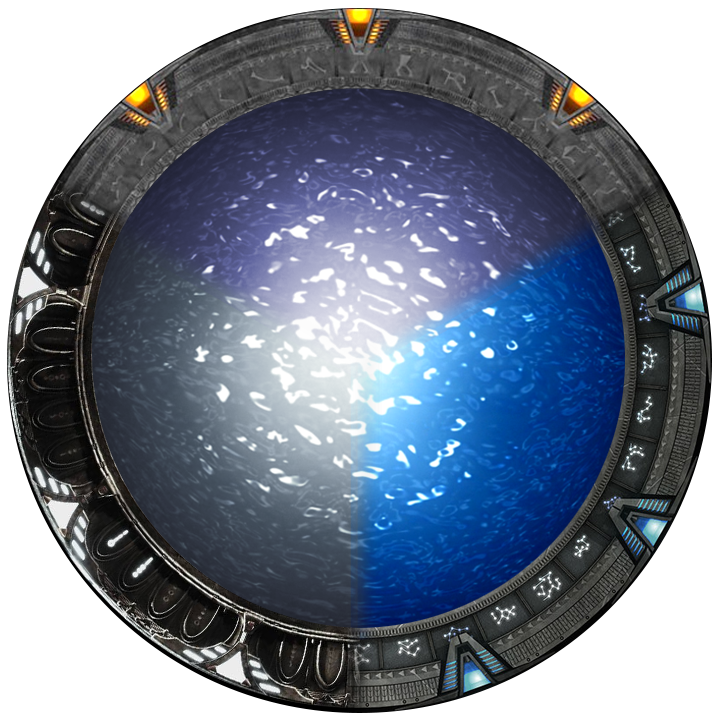
Now this has me thinking about the wormholes in Stargate. I never quite understood why the wormhole had a shakey “going down a waterslide at a theme park, but in space” vibe.
Because it looks cool
It’s round. It has to spin!
I’ve always thought of scifi being very adjacent to fantasy.
Dune, star wars are basically fantasy stories packaged with scifi elements.
I’ve always wondered what makes a SciFi story SciFi and I’ve come to the conclusion that for it to be SciFi it must be an exploration of how technology effects the human condition.
What do you think?
Definitely adjacent. The distinction as I understand it basically boils down whether or not there’s magic.
Like Star Wars has a lot of sci fi elements, but then space wizards who use ‘the force’ which is just space magic. Fantasy.
Dune I’m less familiar with - never read the books. Saw the first movie but was kinda distracted and never have it my full attention. Main character definitely showed some magic super power stuff, but idr much outside of that.
Most of them kinda toggle back and forth, like Interstellar is mostly sci-fi with a sprinkling of fantasy up until the black hole scene, then it’s mostly fantasy with a sprinkling of science.
Or there’s Star Trek, which of mostly grounded in actual science and theory, but it’s got a sprinkle of space magic here and there too.
Not many purebreds.
One thing that absolutely stuck with me as an idea was the plot premise of the short story The Road Not Taken by Harry Turtledove. In this story not only is FTL travel by gravity manipulation possible, but also very very easy to discover. It’s so easy that many aliens discovered it early on and then their progress on technology is basically halted. So humankind is a very advanced civilization because we never discovered FTL travel which led to our advanced technology. Then one day one of the “prehistoric” alien races try to conquer the earth and can’t grasp what they’re up against.
Spoilers ahoy! (yes, old series. Still.)
spoiler
This sounds like the opposite side of the coin explored in the Worldwar series, where the aliens have sublight drives and very ergonomic military equipment – but at a level where Earth WW2 kit is close enough to be dangerous.
There are several scenes where the aliens are crowing about how they’re going to give medieval knights a whuppin’, based on probe data they’d seen from like 1200 AD or so.
Then in a later book, humanity discovers FTL and shows up at the alien home planet with an embassy. The implication was that the alien empire wasn’t going to be quite so supreme after that…heh.
Anne Leckie’s Translators. Aliens so alien that the only way we can have any shred of common ground is by them taking a few humans and rebuilding them specifically to be their ambassadors, with interesting results.
highly recommending this series as well. the ships soldiers are pretty interesting as well
Okay, but that human translator thing sounds like something similar to what we see in a single episode of Sliders when we are introduced to the Kromagg. Except the one human translator you see is still seen as an inferior being.
Would have been a cool plot point had they not completely dropped it in season 4.
It’s hard to describe if you haven’t read it without just spoiling the books, it’s a fantastic bit of writing, and very integral to the story
Is this from Translation State? That’s what came up when I searched Anne leckie translators, but sounds like something I’d enjoy.
Have you read Embassytown? It has some funky linguistics going on that sounds like it might be up your alley
It’s a theme that runs through the Ancillary series, and is further expounded on in Translation State. I like the latter, but the way she writes them in the series is something else, it’s an incredibly imaginative and funny piece of writing. I love those three books, I think they’re amongst the best sci-fi ever committed to paper.
I haven’t read it, but I will now I reckon, thanks for the recommendation
Translation State is a standalone book in her Imperial Radch universe, which includes the Ancillary Justice trilogy, which is a great series. I highly recommend it.
A Translator appears in Ancillary Sword, and it’s pretty much “try to simulate a human” silly stuff for comic relief.
piers anthony has a series called I think kirilian quest. There is no ftl and the law of physics as we know them can’t be circumvented (I think its been awhile but maybe its real difficult and rarely used). Anyway all civilizations eventually realize astral projection is possible and time and space make no difference. Thing is it takes two types of people to work. People with strong auras can project and people with weak auras can be possesed. Its not a requirement but more it will work better and last longer. Anyway people with the strongest auras get jobs traveling and people with the lowest get jobs as vessels. This is how communication between societies in an intergalactic culture communicate and interact.
Yea thats pretty cool definitely gonna check this out
just one word of warning he is more of a fantasy writer so the alien species are a bit fantastic. On the other hand they are not all humanoid. In fact quite the opposite. So sci fantasy but definately different.
One more warning, he’s a chauvinist pedophile
my favorite trope that i dont see enough of in movies is realistic galactic travel and all the tech that would require… travel to another star system… usually multi-generational attempts. feels like there is a lot of this in books.
you often see a brief glimpse, or some hand waiving with hibernation techniques. not much feels real.
The issue with multigenerational stuff in movies is that you would need a new cast for each generation. Foundation series is for example very hard to adapt and they diverged from the books to make things more convenient by having the emperor clone himself and cryosleep. I think currently it’s very hard to get a series through that requires people to pay attention when they’re literally on their phones while watching.
Fully agree, give me non-ftl space is really really fucking big scifi and I’m a happy camper
I have just finished Peter F. Hamilton’s latest excellent duology The Archimedes Engine and The Helium Sea and slower than light interstellar travel, and the time dilation that ensues, is a constant theme. There is some hand-wavy
magictechnology for speeding ships up to 99% of lightspeed (and slowing them down again) using massive gates, which means the main parts of the story are told over decades.
Chasm City has a pretty realistic take on generation ships.
Oh yes, and the deep dark fear of people on the first ever flotilla that someone back home will build a second FTL capable one that would OVERPASS them before their destination and they would arrive to an already colonised world.
ill take a look, thanks!
I’m a big fan of Adrian Tchaikovsky’s work, but one concept of his that I am fascinated by comes from his book “Alien Clay”:
Spoilers below
On the planet the protagonist finds himself on, life has evolved to be fundamentally symbiotic to an absurd degree. Essentially, individual organisms specialize in something… say… jumping. And then they offer their services to whatever macro community comes along. So “creatures” are just communities of individual, highly specialized members who are essentially all free agents. Just wild.
Not gonna read the spoiler because I already have it on my list to read, but I really enjoyed the children series. Excited to get to Alien Clay now
I can’t believe how prolific that guy is. He puts out like 3 novels per year, and the vast majority of them are absolute bangers. Just finished book 4 in the Children series the other day, and it blew me away.
Nice didn’t know a 4th was released
Yup! Just a couple months ago.
A universe/dimension where everything takes place inside a giant creature can be pretty fun one. The bloom in torment: tides of numenera is the example I recall but I’m sure there’s more.
My current favorite topic is the idea of a world ark, a self-contained world adrift in space containing the remnants of life from a doomed world, and the inhabitants aren’t aware of it. Intetestingly it has been featured in two different games: SOMA and Genshin Impact. I’m currently working on a TTRPG campaign within such a world.
I don’t know if this is the same or at least similar, but I’ve always been fascinated by the idea of a generation starship that is moving toward the universe either toward another planet, in search of another planet, or simply as an indefinitely mobile home. It’s wild to imagine generations being born and living on the starship without having any real understanding of the place that humans came from. Stories of Earth would start to seem like wild folklore and mythology rather than actual human history.
Eventually, some generations may become angry that the decision to live on this starship was made by other people many generations before them, and now everyone on the starship is cursed to live under that decision. Was the starship navigation designed so that people may one day change the course? Or perhaps enormous safeguards were put into place to ensure that the ship kept going toward the initial objective because all other options were decidedly much much worse for everyone.
Eventually, some generations may become angry that the decision to live on this starship was made by other people many generations before them, and now everyone on the starship is cursed to live under that decision.
In Genshin Impact, it’s not known by the vast population that the planet they’re on isn’t a normal world. But it’s expansive enough that I think most people wouldn’t have much opinion either way. It would be like telling you that you’re trapped on a chunk of rock suspended in space. Well, yeah and?
If you haven’t read his books, Stephen Baxter has at least a couple of good explorations of long journey ships.
I’ve been thinking of an idea like this for a while. A bubble of stars and planets preserved from a dying universe, either doomed to drift the void for eternity or perhaps lucky enough to stumble into a new existence. Either way, I imagine people on worlds with a countable number of stars in the sky. Think of it as almost the same as a world arc, but on a local cluster scale instead of planetary.
I really like sci fi settings where there is one major leap of physics that has ramifications across the rest of the setting.
Mass Effect is my prime example with the discovery of mass effect fields that allow the manipulation of how much mass things have. This is the basis for local interstellar travel after using a mass relay, as the mass of the ship is reduced for acceleration greater than the speed of light. Artificial gravity is created by increasing the mass of the floor. Guns work by electromagnetically accelerating bullets through a reduced mass field for greater acceleration, while shields work by emitting repulsive mass effect fields.
In The Expanse, the only technological breakthrough that doesn’t feel like a natural extension of modern technology is the Epstein Drive. The only thing it does is make propulsion engines fuel efficient enough that they can burn nonstop between destinations, which allows a ship to constantly accelerate to its destination instead of reaching a maximum velocity then floating the rest of the way there. It cuts down travel times between planets from months/years to weeks, and allows the society presented to exist.
Since I read Stranger in a Strange Land long ago. I keep coming back to the idea of an indoor lawn.
It’s an idea that seems fairly complicated when you get into the details, but also there’s no real reason it can’t be done.
I love that, of all the out-there ideas in Stranger in a Strange Land, that’s the one that sticks with you. Honestly, I think you’re right to favor it! 😄
I was a building engineer for years and this sounds like an absolute nightmare, but it would definitely be super cool.
People permanently grafted into ships is pretty cool. That does come up a lot, doesn’t it?
Something like it comes up somewhere in Scalzi’s Old Mans War series. One of the later books, I think. That’s from aliens giving a human “brain in a jar” treatment, though – not sure if it quite counts as being grafted into the ship.
You know I’d say that’s pretty close. I forgot I should read those, somebody recommended that to me for liking Enders Game
I loved Ender’s Game when I read it as a kid. The followup trilogy was also intriguing, but I kind of lost interest during the 'Shadow series. Maybe around 2002?
Looking again now…wow, the author really expanded the setting! I had no idea he’d added even half this much.
In Christopher Paolini’s book To Sleep in a Sea of Stars there are people whose brains have been removed and installed as ship minds to augment ship functions. There’s some discussion about what it cost and whether it was worth it.
IIRC there was something like that in Gene Roddenberry’s Andromeda. The FTL method in that series requires a sentient biological mind to navigate it. In “The Sum of Its Parts,” the crew encounters a race of artificial intelligence that has found a way around this problem…by simply taking the brains from sentient biological beings and basically using them as specialized processors for FTL calculations.
There were definitely a few other instances of that happening on accident but I think the conjoiner drives were the only ones that were on purpose.
Nah, Chronicles of Riddick has ship telepaths who live in pods. Battlestar Galactica has something similar. The video game Homeworld had galactic travel ships that were controlled by a human grafted to the computer, that turned out to he reversible and had lower stakes as time went on. That’s probably the closest thing because the ship controller is responsible for plotting hyperspace jumps by ripping holes in reality.
The navigators in Dune are almost like this but you can carry them offship in a giant fishtank. So not grafted but kind of non-ambulatory outside of spaceflight.
I guess the theme I latch on to here is people who trade their body and autonomy to gain interstellar flight and provide for others. Is it not the same with conjoiner drives?
My bad I thought you were talking about within the Revelation Space universe. Great examples of that trope in different media. Didn’t know that was a trope used in homeworld I didn’t pay much attention to the story when I played it ages ago
Warhammer 40k, more or less with cogitators and servitors - no automation is allowed after an AI uprising tens of thousands of years ago. All processing is done by lobotomized and heavily modified humans. Many of these cybernetics are built into ships.
Ork FTL ships are built around the brain of an ork ‘weirdboy’ or psyker (sometimes).
That’s RIGHT! I knew there would be something 40k related but I completely mind blanked the cogitators. Did the Mechanicus ever put one of those in charge of driving an entire ship?
I’m not too knowledgeable, but there are lots of edge cases. The machine spirits of the largest mechas (Titans) are known to have some autonomy and individual personalities, which is to say, they probably have some illicit AI or a less disabled human consciousness (-es) at their core.
Anne McCaffrey’s The Ship Who Sang has children with severe physical disabilities given new lives, bodies, and possibilities as ‘shell people’ - brains grafted into ships. An amazing new view on what it is to be human.
There’s lots of ship-who-something books written all or in part by Anne McCaffery, they’re all pretty good. I enjoyed City who Fought, also.
It’s so hard to choose just one. Relevan to OP’s post <spoiler>is a part of Revelation Space where someone is pushed into a long elevatr shaft on a lighthugger, and she uses the Conjoiner engines to stop her fall relative to the ship, and ends up beating her assailant to death with the floor and ceiling as she adjusted the ship speed back and forth at 10g.</spoiler>
In Adrian Taichovsky’s “Alien Clay”, there is a planet inhabited by symbionts. Everything is symbiotic with everything else. You’ll have a creature, but it’s made up of a critter that can digest food, a critter that can see, a critter that can move, a critter that can defend itself, etc.
Neal Asher’s “Polity” books depict a future where AI has taken over, and it’s a good thing, because humans are such murderous evil dipshits.
“A World Out Of Time” had a guy who was frozen, woke up in the future, was forced into becoming a bussard ramjet pilot, and his attempt to get away from this situation landed him in another, weirder situation. There was a weapon mentioned in this book that would make you wish for death. “If you lie to me, you will take your own life. When I let you.”
The Well World, divided up into hexagons, each hex having an entirely different climate, ecology, and technological rules.
Another thing I like is all the various propulsion methods that different authors come up with. Conjoiner engines, is just one example. Niven wrote about a type of hyperspace that moves at exactly one speed, (Or another, faster speed) and looking outside the ship will drive you mad. Alderson drives work instantly, but you have to be in exactly the right spot for it to work. The rest of the time you’re stuck with fusion rockets accelerating as fast as the humans on board can stand.
I love Neal Ashers space operas and almost never see anyone else mention them! So nice to see this!
Neal Asher’s “Polity” books depict a future where AI has taken over, and it’s a good thing, because humans are such murderous evil dipshits.
Effing Neal Asher. The Polity books are just “The Culture is too woke, so I made the libertarian version and my bad guys are cardboard cutouts of conservative stereotypes of liberals and anarchists lol.”
I fuckin’ can’t stand that guy.
I noticed that sort of thing appearing in his later novels.
The book writing technique of the D’ni from Myst. It was not magic, it was essentially math and virtual reality. It just was in hand written books you could enter by placing your hand on a window instead of walking into a big room like the holodecks of Star Trek.
Sounds interesting. Is this from the game Myst or is there another piece of scifi that goes by the same name?
The details of how the books work mostly comes from the book series, specifically The Book of Ti’Ana, which IIRC is the second book in a trilogy. I haven’t played more than the first one and a little bit of 3 tho. Always wanted to play Riven after reading the books, since they all take place right before the events of that game. But the book series and the games were written by the same people, so it’s all the same lore.
A tardis from Dr who. It’s a living spaceship + time machine.
It also has some insane features like:
-
It’s bigger on the inside. In fact it has infinite rooms and storage.
-
It also has access to all knowledge across time.
-
It can instantly translate all languages telepathically. So everything you hear and see will automagically be in your language.
-
It can take any form physically. On both the inside and outside. It has a chameleon circuit which makes it blend perfectly into the surroundings.
It’s said that it’s destiny to be chosen by a tardis. It reads your thoughts and takes you where you want to go or where you are needed.
-
The wormhole network of the Nasqueron Dwellers in “The Algebraist.”
Niling d-sinks, from Peter F Hamilton’s Commonwealth novels.
The Planet Express ship from Futurama (it would take too much energy to move the ship at FTL, so it moves the universe instead.)
Planet express ship is cool and all but I think the finglonger takes the cake