Well, an important detail is that, as your professor I would already know you cheated beyond a reasonable doubt. The only reason to use such a tool is to make it harder to deny.
Imagine an Ivy League classroom of 100 students, as you said. First of all, they all suck at writing in their own quirky ways. By contrast, AI has no rhythm, clumsiness, or voice. It writes like a corporation. If you’re being accused of using AI, that’s not a compliment.
Anyways, here’s another thing about these studies. Counterintuitively, a 1% false positive for a tool like GPTZero doesn’t mean that if I feed it 100 human essays from my creative writing class it’ll get one of them wrong.
It’s more like if there are 100 “types” of creative writing, 1 of them would be wrong consistently and the other 99 almost never. For these tools, there are types of writing they can’t ever figure out, like blind spots (probably from lack of data). A college essay is not going to be such a blind spot.
Here’s a known blind spot: if you have two humans collaborating on a paper, GPTZero will fail. So one person writes, the other extensively re-writes — like a translation. You end up with an inauthentic mess that throws up false positives.
If you’re looking for studies, go to Google scholar and type “GPTZero accuracy specificity” or something make sure you set it to 2025 or later, since GPTZero is rapidly improving. Most studies don’t target creative writing though, because like I said it basically doesn’t get those wrong and scientific articles are more difficult.
I’m an expert in my field. Do you know what specialization looks like? If you spent 70% of your waking life reading you’d be pretty fucking confident about reading as well. Literacy, how terrifying.

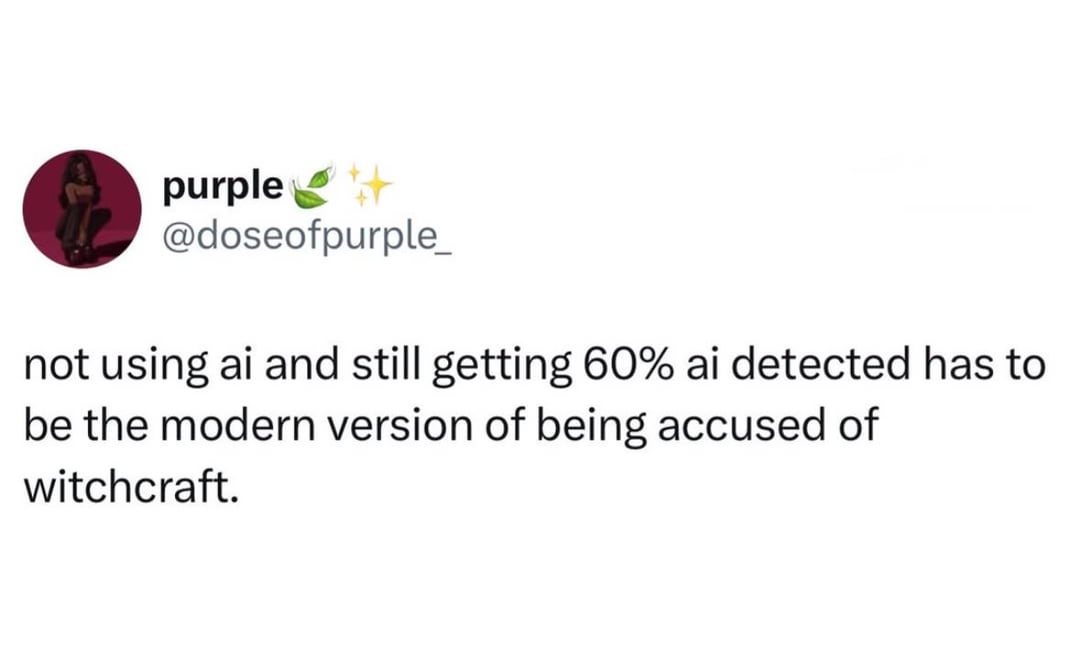
Well, an important detail is that, as your professor I would already know you cheated beyond a reasonable doubt. The only reason to use such a tool is to make it harder to deny.
Imagine an Ivy League classroom of 100 students, as you said. First of all, they all suck at writing in their own quirky ways. By contrast, AI has no rhythm, clumsiness, or voice. It writes like a corporation. If you’re being accused of using AI, that’s not a compliment.
Anyways, here’s another thing about these studies. Counterintuitively, a 1% false positive for a tool like GPTZero doesn’t mean that if I feed it 100 human essays from my creative writing class it’ll get one of them wrong.
It’s more like if there are 100 “types” of creative writing, 1 of them would be wrong consistently and the other 99 almost never. For these tools, there are types of writing they can’t ever figure out, like blind spots (probably from lack of data). A college essay is not going to be such a blind spot.
Here’s a known blind spot: if you have two humans collaborating on a paper, GPTZero will fail. So one person writes, the other extensively re-writes — like a translation. You end up with an inauthentic mess that throws up false positives.
If you’re looking for studies, go to Google scholar and type “GPTZero accuracy specificity” or something make sure you set it to 2025 or later, since GPTZero is rapidly improving. Most studies don’t target creative writing though, because like I said it basically doesn’t get those wrong and scientific articles are more difficult.
I’m glad I never had you as a professor, your overconfident arrogance is terrifying.
I’m an expert in my field. Do you know what specialization looks like? If you spent 70% of your waking life reading you’d be pretty fucking confident about reading as well. Literacy, how terrifying.
All the experts I’ve known didn’t need to tell me. It was just obvious.