
I love talking to people that I know with range anxiety when I know they could charge every night at their home.
And then they start on about “What about long trips?”, and I’ve known them for over 20 years, and the only travel they’ve ever done is from the airport.
Seriously, are they getting paid ? I don’t get why they feel obliged to just talk about scenarios that don’t even apply to them.
As someone who doesn’t own a car, it’s wild to me that people will buy something for the extremely rare times they’ll use that feature.
Renting a car for the weekend is a thing, folks…
I’ve done the maths trying to justify not having a car.several times. Eg, just uber or public transport
I am so damn close!
I did the maths back in 2017 and got rid of my car. Calculated that if I took two or less car trips per week, it was cheaper to get a taxi for those than to pay for ongoing maintenance, registration etc.
For clarity, I’m not saying everyone can not own a car, but most people definitely don’t need a yank wank truck, or a car that drives 1000 km in a single go, for the vast, vast, vast majority of their trips.
I think there’s a case to be made that if one must have a car, and they have the option of choosing an electric car, they should do that, and in the rare cases they need a car that runs on fuel for range or lack of charging options, just rent one.
I hope you get some more transport options near you soon to tick you over to the car-free life!
Not buying more car than I need was definitely something I thought about when I bought mine. It’s okay that trips I do every 2 or 3 months need a charging stop. I was taking a break during those anyway, so the smaller battery size is fine.
I have a mate who genuinely drives across australia. For leisure, he’s a travelling man. He"s done melb to broome, to busselton, followed the 'ghan, whole kit and caboodle.
He does it in a divvy van he’s had converted to lpg.
A bloke at work years ago told me a cool story. He went way way up north to visit a mate. It was either Cooktown ( before bitumen ) but I think even a lot further, I just can’t recall.
Anyway he gets to the area or campground where his mate was staying. Absolutely pissing down. He finds the ranger and asks where “Bill” ? lives.
The ranger steps outside to direct him, still pissing down. He looks at this blokes ute and asks if he had just got here in that ( I mean of course ) then asks if he drove past or through "such and such massive puddle " down the road kinda thing. Yes of course. Ranger says he’s pulled out three 4X s that day already. Bloke was in an ordinary Falcon Ute. He just drove right up on the side of the puddle ( probably a lake really…) and got past it.
Common sense isn’t so common, and yeah too many people head out into places that they’re unaware of the dangers that are possible or the skills that could come in handy.
And then they start on about “What about long trips?”, and I’ve known them for over 20 years, and the only travel they’ve ever done is from the airport.
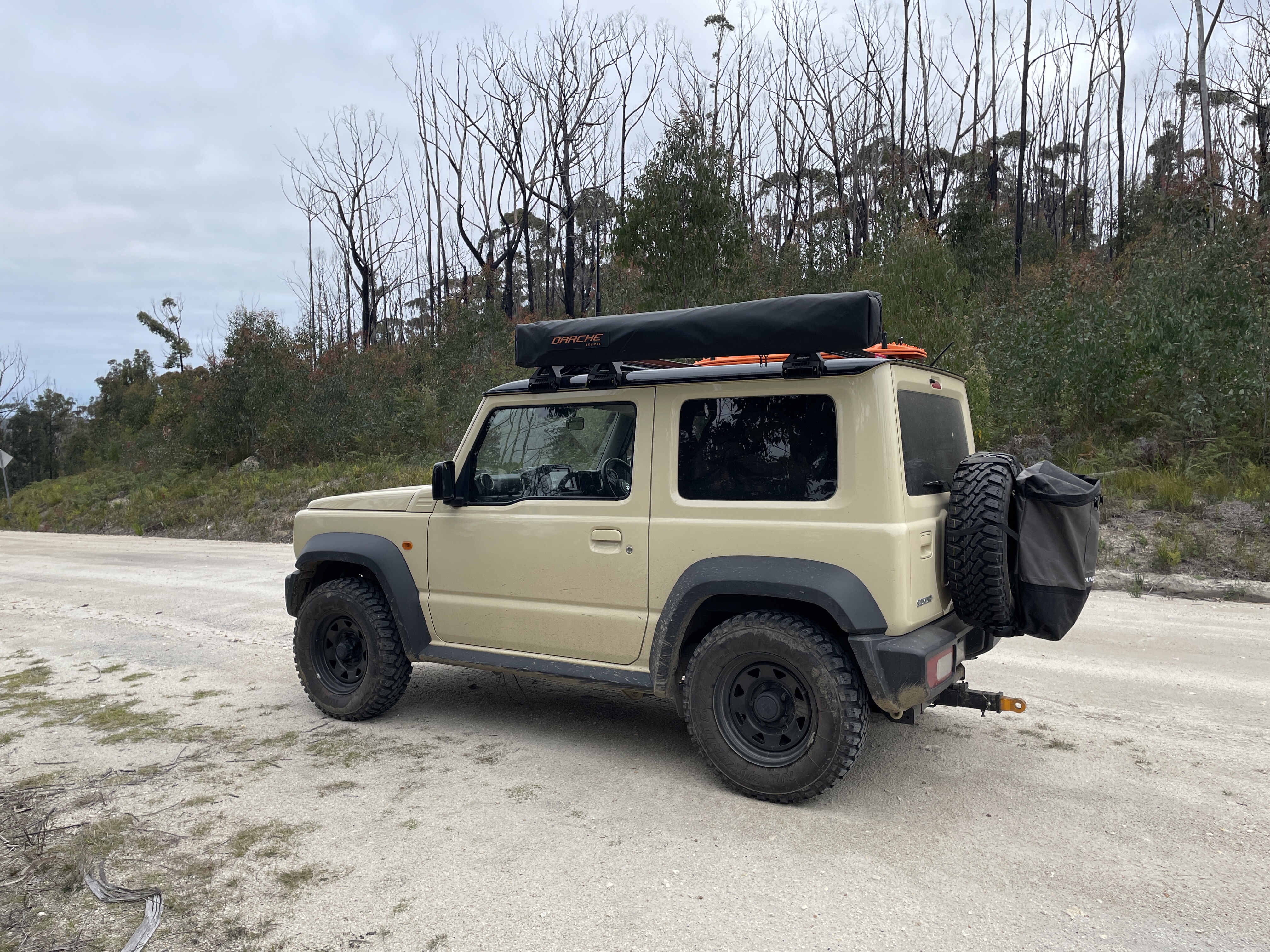
This is also why they buy those massive 4WDs as city and suburban people. It’s for the imaginary off road camping trip they are definitely going to go on…one day. Could just buy a normal car and hire the 4WD, but no - they plan their entire life around the one thing that will never actually happen.
The funniest part is that if 90% of those cars attempt actual offroading, the cars will kill themselves, or, the driver will kill the car, having absolutely no clue how to drive off road.
Several years back, I was in a Prius C, hybrid, trying a shortcut through some empty truck loading dock areas, to get around an accident at a fairly major intersection not too far away.
… Me, in my little putt-putt subcompact… found myself blocked by… it must have been a Ford 350.
He had come up to a puddle.
A 3 inch deep puddle.
But it was really broad, wide.
This fucking moron was evidently not from around here, doesn’t cut through this completely flat parking lot that gets puddles like this whenever it rains, which is often.
So I carefully mount a bit of a curb, with two wheels, (again, in my subcompact hybrid) to drive around this lost idiot. I carefully dismount the curb, with him honking at me the whole time, and then make a rooster tail in the 1/8 mile long, 3 inch puddle that him in his F 350 can’t fucking figure out.
When I got home, I checked my undercarriage for any damage.
Nothing.
Also, no electrical problems either, in the following months, in my hybrid, that 90% of local mechanics say has electronics that are too complicated for them to even touch the car for anything semi-complicated.
Truck people are not worthy of drawing breath.
Suburban people buy SUVs because they’re big with lots of space, and they’re safer. It’s a circular thing too, because when everyone else has one you need one to be “safer” in an accident, rinse and repeat.
99% of them aren’t 4WD. The number of actual 4WDs you see driving around are negligible. Most SUVs don’t even have a AWD option, let alone AWD.
Suburban people buy SUVs because they’re big with lots of space
And also they don’t want to admit to themselves they actually need a minivan.
That’s the loss of space part, but minivans are more like regular cars than SUVs in terms of safety.
Unfortunately the best way to avoid dying in a car crash because a SUV hit you is to be in an SUV.
Don’t get me started on the SUV thing.
I seriously question how often they leave the tarmac, and would love to see proof if they are ever put in 4WD mode.
Meh, most of them are probably 2WD and only pretend offroaders anyways.
I suspect much of it is a fear of change. People are looking for a remotely plausible reason to dismiss it, even if it doesn’t apply to them, because it means they won’t have to modify their behaviour. You can see this with plant based diets, public and active transport, and cooking and heating technologies such as induction cooktops and heatpumps.
The plus side is that the moment people actually make the change, they rarely go back. See also congestion pricing across the world, where the view of it is negative right up until it’s implemented and it almost immediately becomes popular.
TL;DR: You can’t charge in remote areas in central Australia.
If you live in a city you can charge almost anywhere. All major highways are covered. Check PlugShare for charger locations.
If you can charge at home, you’ll get cheaper and more convenient electricity.
If you look at charging in remote areas, you might be surprised.

That’s just fast charger coverage, the ones you use during a road trip. Every three phase outlet, 15 amp caravan power outlet or plain old 10 amp outlet is also good for a charge if you’re stopping overnight and have the appropriate connections.
There’s holes deep inland where you can drive 500km away from a charger and then be unable to get back, but they’re a lot harder to reach than you’d think. Almost nobody goes to those places, that’s why there’s no infrastructure there.
Electricity network providers are pushing the NSW government to relax rules blocking them from entering the Sydney EV charger market, arguing the city’s rollout is falling behind as drivers struggle to find somewhere to plug in.
The electricity network providers want to be able to compete with their own customers, and that’s the claim they’re using to justify it. That doesn’t make it true.
Meanwhile, those same network providers are often taking months to get around to grid upgrades to connect new fast chargers. I think the one at Erina Fair was sitting there for six months before it finally went live.
Yes, really. I recommend checking plugshare (linked above) to find chargers before complaining about the lack of chargers.

Please check what kind of charges are they. majority < 8Kw. It is not good even for destination charger. It would be pretty good for home, but not a place where you have to take your car to recharge.
As long as Plugshare data is accurate. A lot of towns only have a 3kW public charger.
No one does the maths to determine that it would take 20 hours to fill a 60kW battery.
Some have 7kW and some even have 22kW, so you can park your car in a side street for 3 hours before you can continue your journey.
Fast DC chargers are available in main highways, and more are being installed all the time, but just because a charger is shown on Plugshare; there is no guarantee that it; A) will be in service, B) will charge your car in a reasonable time, C) will not be occupied.
Plugshare has this cool feature where it tells you if a charger is a rapid charger or a destination charger. The orange ones in the image are rapid chargers. As you can see, they are not just on highways.
Plugshare also has a rating system to give you an indication of reliability, user reports so you can see if it was working recently, and even has integration with several charging companies to give you realtime information about how many chargers are available or in use.
The old tritium chargers had reliability issues, but the newer chargers seem to be a lot better so far.
Most people’s home electricity isn’t enough to charge an EV for daily use btw.
I think you may be gettting US information interference, our 240VAC grid is well enough to charge even from a standard 10A GPO (standard socket outlet in your house).
Things are a little different in the USA where the grid is 120VAC and they would be getting literally half the speed we do, and then they would want a larger outlet connection or hardwired dedicated charger which can deliver T2 charging speeds.You can charge from it, but not enough to keep up if you’re driving further than just around the corner to work every day and can’t charge at work.
240v charging adds 10-12km of driving range per hour. If your car is plugged in 12 hours from 7pm to 7am you can drive at least 120km each day. That’s a lot further than “just around the corner” - that RACV page also notes that the average commute is about 30km per day so you only need 3 hours on an ordinary mains.
I did rideshare driving for several years using just a standard 10A outlet. I can promise you it’s fine for over 99% of people.
The only reason I upgraded to a 3x faster charger was because it had a cable mounted to the wall which was more convenient.
If you only charge overnight, a 10 hour charge will add 24kWh which is about 150km. If you absolutely must drive over 150km per day (7 days per week) and you can’t charge at home for more than 10 hours per day (even on weekends), you can stop at a rapid charger once per week. It’s still cheaper and more convenient than petrol.
Some more numbers from the RACV to dispel the EV misinformation
- “Slow” charging from a 240V mains charger adds 10-12km of range per hour charging.
- The average commute is 30km per day, so about 3 hours on mains should be sufficient for average driver.
Yeah it is. I ran my EV from an 8 amp charger for the first year. Charging for ten hours overnight adds about 100km of range. Most people don’t do many kilometres per day.
You only really have trouble if you’re doing back to back long trips, or if you haven’t charged for a couple of days and suddenly find out you have a long trip to do the next day.
8 amp? Normal wall power point is 10 amp.
The early Tesla mobile chargers only did 8A from a 10A socket, something about a 20% derating. They don’t do that anymore thankfully.
That charger advertises 8 amps to the car, so that’s what the car draws. I’m not sure why. A safety margin for bad wiring and dodgy outlets, maybe?
Yeah , 10 amp outlets aren’t really good for 10 amps for 10 hours. Especially as they age.
I charged my EV for a few months with its trickle charger and it drew 10 amps. I just made sure to plug/unplug the charger from the outlet every day to ensure the contacts were wiped clean, and I checked the plug a few times after 4 hours or so to make sure it wasn’t getting hot (it wasn’t).
But yeah, home charging overnight is fine for city use. Most EVs use about 170Wh per kilometer driven, so 2400 watts per hour from your charger gives you about 12-15km of range every hour. If your daily commute is under 100km it’s fine.
I’ve got a 7kW single phase charger now, it charges my EV from dead flat to 100 percent in less than 10 hours.
Yeah there’s not a lot of petrol stations that way either.
But if it’s a problem, rent a gasser.