Increased height for structure, likely increased weight as well since you need to make super-duper sure they don’t pancake somebody’s car. This leads to;
MUCH greater chance of property damage and resulting payouts (not to mention the risk of somebody’s Timmy managing to shock themselves)
Harder to build and maintain due to number 1, as well as having a bunch of cars around, needing to schedule lot closures, etc.
Number 3 gets in the way of actually using the parking lot as a parking lot, which is probably going to be pretty unpopular with the property owner and/or lose them money from decreased business.
Oh yah, harder to angle due to the constraints you’re under, so less efficient.
All this adds up to making it a lot more expensive than just putting them on the ground. We have TONS of abandoned malls and supermarkets all over the country, just use that smh.
i remember when i was five on the top floor of a parking garage i touched the solar roof on my great-great granpappy’s fisker karma and got a nasty shock. Shocked the gay right out of me. But then i touched some exposed wiring on one of the tall lampposts and that turned me Bi so who’s laughin now gramps
coincidentally, the lamppost then also fell into his car, and he renounced his commitment to the environment and bought a Hummer h2 with his fat insurance payout
What insanity is this, have you ever been in a parking garage where most are like 8ft ceilings. Most solar car parks are well over 12ft and no issue with building them. Yeah it’s more expensive to build solar car ports vs ground based but you don’t need to build big transmission lines which delay or prevent many large solar fields. Then hopefully you can have EV charging stations right there power cars off the sun.
It’s either a roof structure by itself or adds another ~3cm of height to an existing roof.
You vastly overestimate the weight of solar panels. The ones shown probably weigh ~20kg, and probably ~35kg with framing etc. Most car roofs are rated to 30-150kg of dynamic weight. In the statistically highly improbable event where the structure completely collapsed it certainly will not “pancake” anything and will likely just be cosmetic damage.
“somebody’s Timmy managing to shock themselves”
No more dangerous than any of the wires that are, probably, within a few meters of you as you read this.
“Harder to build and maintain” sure, but not by much and nothing requiring the full lot closures you’re imagining.
“harder to angle” Sort of, there might be instances where a suboptimal angle results in better aesthetics, cheaper materials, snow clearing, etc. but we’re talking ~10-15% efficiency loss.
Based on the shoddy logic and non-existent research I’m guessing this isn’t really about the solar panels. You wanna share what the deeper concern/peeve is?
My concern is people advocating for expensive and ineffectual strategies because it looks cool in a social media post instead of doing things that are actually useful. We have an insane amount of land to use. Do public transit, do utility-scale solar. Don’t do this nonsense.
Oof, I 100% feel you there. That is a huge problem and those 2 suggestions are critical things that need to be done more of. I’m 100% with you that pretending like these dinky little instillations are at the scale of what is needed is ridiculous.
However. I do think your overall frustration is coloring your perception of this solution a bit. I think you would be shocked at the efficiency possible from a distributed solar network like this.
Yes, a centralized utility scale solar in the “insane amount of usable land” is more efficient both resource-wise due to economies of scale and in generation due to things like sun-tracking. However, it has significantly more transmission losses and labor upkeep.
A distributed solar network’s goal is to reduce those transmission losses by having the generation at point of load and increase local independence/resiliency at the cost of some resource and generation efficiency. It is solving a slightly different problem and so has different weighting on the cost/benefit analysis.
Understanding more where you’re coming from; I get it. But projecting that frustration onto decent solutions to different problems in such a factually incorrect way is not helping.


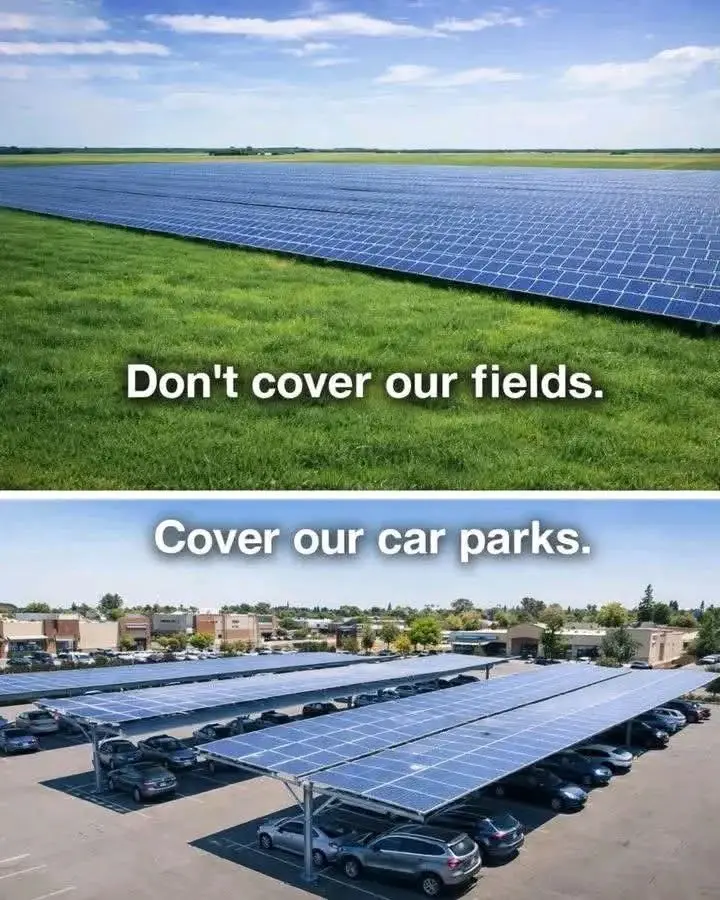
Carport solar is a terrible idea.
Increased height for structure, likely increased weight as well since you need to make super-duper sure they don’t pancake somebody’s car. This leads to;
MUCH greater chance of property damage and resulting payouts (not to mention the risk of somebody’s Timmy managing to shock themselves)
Harder to build and maintain due to number 1, as well as having a bunch of cars around, needing to schedule lot closures, etc.
Number 3 gets in the way of actually using the parking lot as a parking lot, which is probably going to be pretty unpopular with the property owner and/or lose them money from decreased business.
Oh yah, harder to angle due to the constraints you’re under, so less efficient.
All this adds up to making it a lot more expensive than just putting them on the ground. We have TONS of abandoned malls and supermarkets all over the country, just use that smh.
i remember when i was five on the top floor of a parking garage i touched the solar roof on my great-great granpappy’s fisker karma and got a nasty shock. Shocked the gay right out of me. But then i touched some exposed wiring on one of the tall lampposts and that turned me Bi so who’s laughin now gramps
coincidentally, the lamppost then also fell into his car, and he renounced his commitment to the environment and bought a Hummer h2 with his fat insurance payout
What insanity is this, have you ever been in a parking garage where most are like 8ft ceilings. Most solar car parks are well over 12ft and no issue with building them. Yeah it’s more expensive to build solar car ports vs ground based but you don’t need to build big transmission lines which delay or prevent many large solar fields. Then hopefully you can have EV charging stations right there power cars off the sun.
It’s either a roof structure by itself or adds another ~3cm of height to an existing roof.
You vastly overestimate the weight of solar panels. The ones shown probably weigh ~20kg, and probably ~35kg with framing etc. Most car roofs are rated to 30-150kg of dynamic weight. In the statistically highly improbable event where the structure completely collapsed it certainly will not “pancake” anything and will likely just be cosmetic damage.
No more dangerous than any of the wires that are, probably, within a few meters of you as you read this.
“Harder to build and maintain” sure, but not by much and nothing requiring the full lot closures you’re imagining.
“harder to angle” Sort of, there might be instances where a suboptimal angle results in better aesthetics, cheaper materials, snow clearing, etc. but we’re talking ~10-15% efficiency loss.
Based on the shoddy logic and non-existent research I’m guessing this isn’t really about the solar panels. You wanna share what the deeper concern/peeve is?
My concern is people advocating for expensive and ineffectual strategies because it looks cool in a social media post instead of doing things that are actually useful. We have an insane amount of land to use. Do public transit, do utility-scale solar. Don’t do this nonsense.
Oof, I 100% feel you there. That is a huge problem and those 2 suggestions are critical things that need to be done more of. I’m 100% with you that pretending like these dinky little instillations are at the scale of what is needed is ridiculous.
However. I do think your overall frustration is coloring your perception of this solution a bit. I think you would be shocked at the efficiency possible from a distributed solar network like this.
Yes, a centralized utility scale solar in the “insane amount of usable land” is more efficient both resource-wise due to economies of scale and in generation due to things like sun-tracking. However, it has significantly more transmission losses and labor upkeep.
A distributed solar network’s goal is to reduce those transmission losses by having the generation at point of load and increase local independence/resiliency at the cost of some resource and generation efficiency. It is solving a slightly different problem and so has different weighting on the cost/benefit analysis.
Understanding more where you’re coming from; I get it. But projecting that frustration onto decent solutions to different problems in such a factually incorrect way is not helping.