You must log in or register to comment.
Damn I guess I am feeling so fucking good right now. My friends are always down to do a new one. The downside is campaigns have never actually been finished or played more than a few months.
Cries in Cyberpunk
Oh you mean Shadowrun without magic and dragons?
I picked up Cyberpunk when RED came out. Mostly because my table was into it. Compare to the lore and flavour of Shadowrun, it feels anemic.
I mean hacking is basically like magic and nothing stops you from making a cyber dragon or robo dragon or whatever.
Funny story, they added magic and dragon to shadowrun because cyberpunk released first, and they knew they were cooked without a USP.
My group tried Shadowrun, but we kept falling asleep. Counting dozens of dice for every fart you do was just too relaxing for us.
You just need to know how to use a marker and then you throw two handful fo dice and can see the successes instantly…

You still need to count the successes and failures to see the result…
Shadowrun has consistently had a great setting and a terrible system
Honestly I think the dice are both the high and low point of Shadowrun. At low to mid level, when everything that happens requires 6-15 d6, it can drag a little bit.
Counterpoint, once you have your build running, sniping a guy in the head from three blocks away for 162d6 damage is very empowering. Or being able to cleave a man square from head to asshole right through his dermal plating with a vibro katana.
But by and large though SR is loved for its setting more than for its mechanics. Cyberpunk is probably just generally a better TTRPG, no matter how much of a sordid love affair I have with SR.
Cyberpunk has magic. They just call it things like “ice”, or “virus”, or whatever, and use some technobable to explain why it technically isn’t actually magic.
More like a fancy Deus Ex.
I never asked for this.
I finally bought it this summer when it went on sale, and I already am on my 7th playthrough. I think I’m somewhere around 750 hrs of playtime already.
Edit: oof, that’s a lot for 3 1/2 months
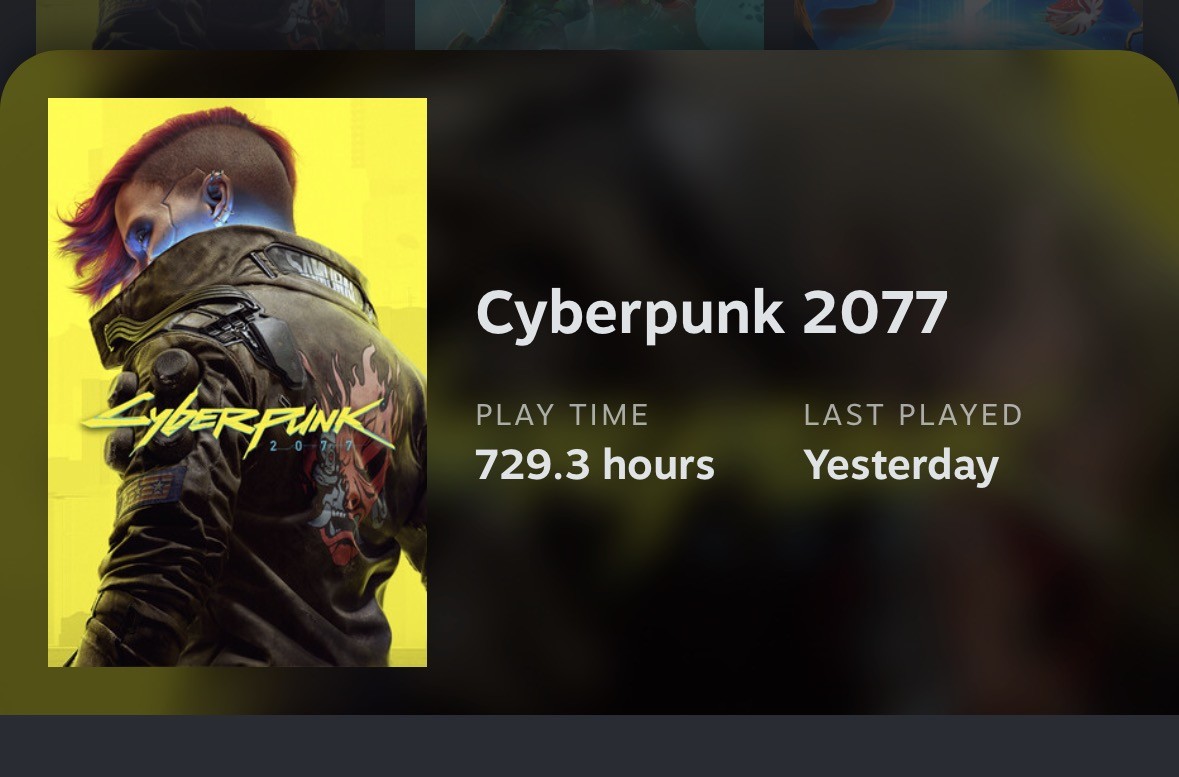
I heard you have to stop when you reach exactly 2077 hours. It’s the law.
I had a friend’s son come to me asking to learn to program so he could make video games. I started teaching him C#, and he thought it was too hard. He said he just wants to learn to make Roblox mods. It was very disappointing.
I used to teach programming to young kids (like 8-12) as a summer job and never had a single kid complain about the difficulty or fail to learn. This was about a decade ago.
I recently tried teaching my cousin (9) using the same curriculum and it was nearly impossible. He didn’t know how to turn his computer on or off and he didn’t know what a file was or what “text” means. I basically had to root his Chromebook to install a competent text editor on it. Then every time the “computer” booted it said something like “press G to revert” in huge text for like a minute straight and I told him never to press it. Took like 2 hours to put the computer in a state where you could code on it, and next session after that it was reset. I was like “what happened to the computer?” and he said “it said to press G so I did”
Kids are fucked bro. I blame Google, Apple, and Microsoft for intentionally designing their software to prevent you from learning how computers work or how to use them. They don’t want you developing any transferrable skills whatsoever. You used to learn all about computers just by using them and it was impossible not to…
OK that “press G” prompt is horrible, though.
We know the younger generations are somewhat cooked, and that, wouldn’t trust a boomer or GenXer with that either. Even for a millennial that’s horrible UX.
It’s designed to trick people. It displays the message for 30 seconds or a full minute (don’t remember) every single time it boots. There is no indication that there is a timer running. If there’s a way to skip it and/or disable it, it isn’t not apparent.
Ok get this: Putting the computer into a state where it will so graciously allow you to install a text editor also requires completely wiping all data on it. Good thing my cousin didn’t know that you could even save data to a computer in the first place! Pressing G to revert it also completely wipes it. Imagine working on something for a week before pushing it to some remote git repo and accidentally hitting that.
They are completely, intentionally fucking up the minds of children to make them dependent for life. We need a new round of Nuremberg trials for big tech.
I hate this problem so much.
This has been a thorn in my side at least as far back as Windows 8, and the LLM craze has only thrown jet fuel on the damn fire
EDIT: I don’t have to deal with kids that much but I’ve noticed that it’s wrapped around to affecting older adults and that’s maybe worse since they’re the same generation as the politicians making decisions for all of us involving technology
I mean, people have different paths of entry into programming, lots of them started by making mods for their favorite game. And Lua is a great lightning-fast language with minimal footprint, excellent for interactive use-cases, that folks keep dismissing for no good reason.
It was more that he just wanted something easy. He didn’t want to work for it. He thought that making Roblox mods would mean he didn’t need to learn to program.
I wonder if there’s some kinda visual environment, maybe in the vein of Scratch, that would trick him into learning programming while not feeling that way. That’s often the approach that one must take not only with children, but even in adulthood when the full-blown subject feels too much for one’s bandwidth.
There’s a whole game studio here that just makes games and mods for Roblox. It really is kind of the example in the OP.
For me DnD was always that mechanics- and story-light thing for oneshots beside the regular ttrpg campaigns… but I guess I’m the wrong age group to relate.
Yeah, I want Skyrim, but superheroes, but not Marvel and not DC. Just build your own superheroes like city of heroes had.
Alsoholyhit, BG3, but superheroes
If you’ve beaten the game odds are your characters effectively were super heroes.
That would legitimately slap. Sadly, I feel like any company big enough to do the concept justice would be too risk-averse unless a big IP is attached.
Justice League but BG3 would be. Well. I think I’d lose my husband for awhile???
Are you saying you don’t wanna smooch Martian Manhunter yourself?
I would, but we have one computer that could run that sort of thing, and I’d let him play first!
DC or marvel would ruin it, but smaller properties could pull it off. I’d play the fuck out of a BG3 style game set in Worm.
Check out the video game Freedom Force. It was such a great BG3 but superheros type game
Looks like it has a mod community. Gonna check out what kind of stuff they’ve done with it
Shoutout to Death in Space for being my primary TTRPG going forward.
I want space ships and lovecraftian horrors that lurk between the stars. And I love that it treats the party’s ship/space station as a shared character.
Only War had the party’s imperial guard regiment as a full on ‘character’ that they made together, complete with stats and traits. Really cool system.
Doing everything in D&D

Doing everything in GURPS

I envy the DMs that have time to learn a new system and the will to convince their players “who just really wanna try DND” that a different system is better
This is my current group, approached by bright-eyed first time D&D adventurers and I turned them all into haggard WFRP adventurers. d100 is a game changing argument btw
oh i fucking love WHRP
“what profession is your character”
“oh, they’re an artisan. a skilled silversmith to be precise, what about you?”
“ah, i just rolled a peddlar”
i need more RPGs that feature classes that are just some guys with no/very few combat abilities
YES! You get it. It’s also great that there is no downside or anything stopping you from starting as a peddlar, getting conscripted into the state army, working your way up to handgunner, defecting, and becoming a river pirate; bringing all of the associated skills from those expiriences along with you through the development of the character.
I am fortunate that I have a good balance of two combat wombats and two social primary-players in our campaign. Not having a wizard could bite them in the ass soon if they don’t start treating my NPCs better though >.>
last campaign I played as an Agitator. I wasn’t any good at combat. I was, however, really good at riling up NPC peasant mobs to go do my combat for me. I liked that campaign
I definitely prefer a d100 system
You don’t need to convince anyone, they’re D&D players, they don’t know dick about TTRPGs - literally run whatever you want and tell them you’ve made a few homebrew changes. They won’t know the difference.
I completely understand this person, but I’m the opposite sort of guy who plays ttrpgs other than DnD.
I’m only interested in games about going into dungeons, killing monsters, and taking their stuff, and my complaint with DnD 5e is that it’s also not the best at those types of games either.
It really isn’t. Either 13th Age or Pathfinder 2e if I want high action high fantasy
My group is playing GURPS right now and I’m really enjoying it
This is definitely something I’ve been frustrated about more so over time. I have a bunch of game books sitting on my shelf just ready to play as soon as I can convince my players that there is something more.
I’m convinced!
I’ve been actively trying to get a group together in person for some World of Darkness for at least 5 years.
I have never managed to get a group to finish a WoD campaign. Most dont last more than a couple sessions. And i can’t even get started on Legend of the Five Rings. Or Star Trek d6.
Back in like 2016 I got a game of vampire going. I pitched it to two non-ttrpg friends as “what if you’re vampires but the head vampire in the city is basically Donald Trump…”. 100% player retention.
Game ran for like two years. Lots of blood. We still talk about how the highlights.
He’s a strategy: get a copy of Microscope by Ben Robbins, and tell them you’re going to use it to create the world/setting for your next campaign (this is something many people do). Once they’ve played, ask them to do a stars and wishes, see what they say (I would be extremely surprised if they don’t love it).
Then point out that Microscope is a ttrpg, just a wildly different one to D&D, and that there are thousands of other games that do weird and interesting things with mechanics that most trad games can’t even dream of doing (e.g. some examples: Everyone is John, Ten Candles, Fiasco, Wanderhome, We Are But Worms).
Viditya Voleti’s A Land Once Magic is another good option that you can do this with, and it’s a bit quicker and easier than Microscope.
DnD is more like Minecraft in that it lays out a nice set of general mechanics that can be tweaked into whatever setting you want. Most ttrpgs I’ve seen don’t play all that differently from DnD
d&d is kind of shit for almost everything. its only good for a narrow pulpy sword and sorcery adventure that asks no interesting questions.
and bitd/fitd is much better faster more adaptable for basically any pulp trash with like 5% adaptation.
d&d is unusable for intrigue or investigation that isn’t fully railroad. the concept of the individual is so central, a player representing anything else is basically unplayable. there’s almost no consideration for the theatrical or collaborative writing elements of the genre.
you just haven’t played any interesting ttrpg’s. you should!
its only good for a narrow pulpy sword and sorcery adventure that asks no interesting questions.
d&d is unusable for intrigue or investigation that isn’t fully railroad.
Dude you just have had shitty DMs
I said only good for. you can wedge other shit in but its absolutely not the right tool. ‘roll to search’ ‘roll to spot a tail’ ‘roll to know if he’s lying’ is not interesting.
systems that are actually good for this shit exist.
The stranger says you can trust him with the money
Player: I want to roll insight
(dm hidden roll: deception: 15)
Insight 14 -> “you aren’t sure he’s lying, but you feel very uneasy trusting him”
Insight 5 -> “you really can’t read his expression”
Insight 16 -> “you aren’t totally sure, but you think he’s going to betray you”
Insight 19 -> “yeah this guy is totally going to rip you off”
The game not being interesting is largely a DM problem regardless of the framework you use.
you think that’s… good?
The mechanics aren’t especially “nice”. It has a lot of legacy jank (15 strength is what bonus?). 1d20+stuff vs target produces a flat probability, which is problematic.
it has a lot of assumptions deeply baked into the rules. You need the adventuring day, to rewrite all the powers, or sharply limit party composition, or it falls apart.
It’s missing or has anemic offerings for whole subsystems - social conflict, meta game currency, succeed at a cost.
Character progression is very coarse. level up and a bunch of stuff happens at once. You can’t make a character that has a shit load of sneak attack without also getting a bunch of HP and other rogue stuff.
The magic system is brittle and poorly defined. There’s not really an expectation or system for players to make their own spells. You pick from a list. If you want to play a game about creating your own spells, it’s going to provide little guidance. Also, most of the spells are about combat, with a handful about movement.
You can change rules, but after a certain point you’re playing something unrecognizable as DND.
Most ttrpgs I’ve seen don’t play all that differently from DnD
Play more games. Even a basic traditional game like Vampire is a mind opener. No adventuring day. No levels. Social conflict. No attrition and resource management. These have a big impact on the experience.
TLDR I feel like I think “Minecraft is anything you can make with any of the mods out there plus in the in-game tools and your own creativity” and you think “Minecraft is vanilla Minecraft played with the main goal of slaying the ender dragon”.
It has a lot of legacy jank (15 strength is what bonus?). 1d20+stuff vs target produces a flat probability, which is problematic.
Yeah these things are the biggest issues with DnD and related games IMO. However, rolling a D20 is a lot of fun, which makes me not want to replace it with something like 3d6.
it has a lot of assumptions deeply baked into the rules. You need the adventuring day, to rewrite all the powers, or sharply limit party composition, or it falls apart.
The adventuring day is a big one. TBH I’ve never seen a ttrpg without it.
There are massive amounts of fan content for DnD out there and easy to find, if you don’t want to write your own. There are whole ttrpgs that are practically modded DnD but tweaked for a specific setting.
I’m not sure what you mean about limiting party composition.
It’s missing or has anemic offerings for whole subsystems - social conflict, meta game currency, succeed at a cost.
Hard disagree on social conflict. DnD is full of mechanics for that. Meta game currency is something DMs usually add in from my experience, although DnD does have inspiration points as a kinda weak form. Succeed at a cost is something I usually see DMs add in, but I have seen other ttrpgs with that more baked into the rules.
You pick from a list. If you want to play a game about creating your own spells, it’s going to provide little guidance.
Yeah that’s fair. If you have an example of a game with a good “make your own spells” system I’m curious.
Also, most of the spells are about combat, with a handful about movement.
Hard, hard disagree there. Off the top of my head: prestidigitation, minor illusion, friends, zone of truth, tiny hut, message, command, good berry, that one that lets you ask god a question…
Play more games. Even a basic traditional game like Vampire is a mind opener.
Thanks for the rec! I’ll look into it.
To give you another rec, which is often named as an intro to PbtA systems for dnd players: Dungeon World. It still borrows quite a few things from DnD (which are imo the worst parts of DW).
And as the other user wrote, reading other system can even be helpful just to steal stuff for your DnD group. PbtA (or one based on it) is one that imo every GM should’ve played, because it teaches so many important principles that are relevant in any systems you play - but in PbtA they are far more explicit (and well explained in the rulebooks).
However, rolling a D20 is a lot of fun, which makes me not want to replace it with something like 3d6.
Fun is subjective, but I personally really enjoy rolling a big dice pool. 4 fire firearms, 3 for dex, 2 for equipment bonus, 4 for the fate blessing, 4 for the gun being magically perfected, 3 for aiming, that’s approximately Get Fucked dice to throw on the table.
it has a lot of assumptions deeply baked into the rules. You need the adventuring day, to rewrite all the powers, or sharply limit party composition, or it falls apart.
The adventuring day is a big one. TBH I’ve never seen a ttrpg without it.
Any whitewolf rpg. Fate. Gurps. Don’t rest your head. Unknown armies. Countless indie RPGs. Many games that aren’t close relatives of D&D don’t have a central model of “you have a limited amount of resources to get through the day”.
I recently started a game of Vampire: The Requiem. One of the guys had only played D&D before, and it kind of blew his mind that he can just do his iconic stuff whenever he wants. He was going to punch a bouncer and we were like “Why don’t you just use your mesmerize?”, and he was like “I forgot I don’t have to save that”
There are massive amounts of fan content for DnD out there and easy to find, if you don’t want to write your own. There are whole ttrpgs that are practically modded DnD but tweaked for a specific setting.
You can also use an actual generic system like Fate or GURPS. Both of those have a ton of fan content as well. This is not a unique strength of D&D.
Hard disagree on social conflict. DnD is full of mechanics for that.
Please share. From what I recall, the system is limited to something like “Roll persuasion vs a DC, and that determines how big of a favor they’ll do for you”, or similar for intimidation.
Imagine a scenario where the players encounter a group of goons blocking the road. If they want to get in a fight, D&D has a ton of rules. Movement, to-hit and damage, armor, saves. If they want to talk through it, the rules are comparably thread-bare. There’s no social HP.
Other systems give you more. I’m pretty sure a lot of PbtA games have social moves. There’s also Monster Hearts, which I never played because you need a particular kind of group for that one.
Side note: because of how D&D’s stats work, you end up with a lot of characters are mechanically bad at socializing, or underperform at their prescribed roles. You have to work against the system to get some concepts. The whole idea of “multiple ability dependent” is a D&D-ism that’s just not in every system. If you want to play a wise cracking dashing axe-man in Fate, for example, you can just do that. You don’t need to worry about how you can get both strength and charisma, nor about if you can just reflavor Hexblade because you don’t really want the rest of Warlock.
Meta game currency is something DMs usually add in from my experience, although DnD does have inspiration points as a kinda weak form. Succeed at a cost is something I usually see DMs add in, but I have seen other ttrpgs with that more baked into the rules.
Inspiration is kind of store-brand fate points, yes. You can easily add more to it, as well as bring succeed-at-a-cost into D&D. But the argument is more about how D&D provides little.
You pick from a list. If you want to play a game about creating your own spells, it’s going to provide little guidance. Yeah that’s fair. If you have an example of a game with a good “make your own spells” system I’m curious.
Mage: The Awakening (2e) is the crunchy one that I know. The book provides a ton of examples, but even those are flexible. You add or lose dice based on adjusting the spell details, and potentially create a pool of fuck-up dice in exchange for more dramatic changes.
Unknown Armies is an old classic that has “random magick” as a thing any duke can pull off.
Fate is a generic system, so it really depends on which splatbook you’re using, or what your table decides on. One game I ran had a “choose one: slow, dangerous, expensive” model for magic. The player can’t picking “dangerous” and things got really exciting.
Also, most of the spells are about combat, with a handful about movement. Hard, hard disagree there. Off the top of my head: prestidigitation, minor illusion, friends, zone of truth, tiny hut, message, command, good berry, that one that lets you ask god a question…
I was curious so I’m looking at a spell list on a dnd wiki. A majority of spells are for combat, followed by spells that also have exploration uses (eg: fly, alarm), and then there’s everything else. But you can’t deny that a large chunk of the spells are explicitly about doing damage, or helping you do damage.
I spent too long on this post. Hopefully it was worth it! “People should play more RPGs, even if just to steal stuff to port into D&D” is one of my bugbears.
Thanks for the recs, I do plan to look into them, but I also want to point out the main reason I stick to using DnD and ttrpgs that are very similar (e.g. pathfinder) as a framework is it lets your group get right into the game instead of spending a lot of time getting used to an unfamiliar system.
Imagine a scenario where the players encounter a group of goons blocking the road. If they want to get in a fight, D&D has a ton of rules. Movement, to-hit and damage, armor, saves. If they want to talk through it, the rules are comparably thread-bare. There’s no social HP.
This would be mostly RP’d discussion, punctuated with rolls to represent luck and stats to represent how the character and player might differ.
It would be something like the player asking the goons to move, the goons saying no, the player asking why, the goons giving some answer, the player rolling insight and then deciding a follow up question, probably ending with a persuasion or intimidation check with a DC dependent on how well the rest of the discussion went, with the possibility for other shenanigans to influence as well (like maybe the party mage used minor illusion to fake a badge to pretend to be cops).
I honestly don’t think something like “social HP” would be better than RP and shenanigans, but idk, I would be curious to try.
Side note: because of how D&D’s stats work, you end up with a lot of characters are mechanically bad at socializing, or underperform at their prescribed roles.
This is definitely a weakness of DnD. It helps if your party is more into the RP aspects than absolutely optimizing their characters for combat. Another thing I’ve done as DM is to give players a choice, like jumping across a gap could be acrobatics or athletics, so they can use the stats they are good at.
I was curious so I’m looking at a spell list on a dnd wiki. A majority of spells are for combat, followed by spells that also have exploration uses (eg: fly, alarm), and then there’s everything else.
I think the issue with combat oriented spells is you have spells at each level that do “vaguely this level’s worth of damage” for every damage type so you get a nice progression curve. Out-of-combat spells are not so easily quantifiable. What is the level 4 version of minor illusion? (There are some answers to that tbh). There also are damaging spells that explicitly have non-combat purposes (one of the main ones I can think of is Phantasmal Force), as well as ones that may not explicitly say so but no DM would deny, like using fire bolt to light something on fire at a distance.
Also I’m not sure what you have against exploration and movement type spells because those are very useful in an intrigue heavy campaign.
Anyway, DnD does have a lot of combat mechanics, but it has plenty of non-combat mechanics too. The combat is more regimented and structured, but I don’t see that as a weakness, just the difference between combat and intrigue.
I also want to point out the main reason I stick to using DnD and ttrpgs that are very similar (e.g. pathfinder) as a framework is it lets your group get right into the game instead of spending a lot of time getting used to an unfamiliar system.
That does have some value, but sunk cost is not always a great justification. Also, a lot of systems are way easier to learn than DND. I think people think it’s going to be as hard as memorizing all the DND jank - stat to bonus mappings, attack bonus by level, spell slots, a hundred different unique spells - but many systems aren’t like that. (Quick, can you Sacred Flame and object? Smite with a thrown spear?)
I’ve been playing Vampire and the guy that’s only played DND before has had no trouble picking up the rules. Fate is maybe easier, though more creatively demanding. Lot of tyranny of the blank page potential there.
It would be something like the player asking the goons to move, the goons saying no, the player asking why, the goons giving some answer, the player rolling insight and then deciding a follow up question, probably ending with a persuasion or intimidation check with a DC dependent on how well the rest of the discussion went, with the possibility for other shenanigans to influence as well (like maybe the party mage used minor illusion to fake a badge to pretend to be cops).
That’s how DND would typically play it out, but some things worth noting.
One, where armor class, saves, and HP are very codified, the DC for persuasion or intimidation is very loosey-goosey in DND.
Fate, by contrast, has a stress track (like hit points) for physical and mental harm. So when your character pulls a knife and says “I’m gonna cut your fingers off one at a time and make you eat them”, and you roll, there’s mechanical oomph to it. You roll +7, and they’re either out of the scene of suffering a consequence. DND is just DM whims.
I honestly don’t think something like “social HP” would be better than RP and shenanigans, but idk, I would be curious to try.
I like how Fate does it. You’re not limited so much by your personal ability to act and the GM’s mode. You roll high on Provoke and it mechanically hits.
Oh, another subsystem from Fate I’d recommend importing: Concede. Solves all those “omg I wiped the party” problems.
I think the issue with combat oriented spells is you have spells at each level that do “vaguely this level’s worth of damage” for every damage type so you get a nice progression curve.
This is almost certainly a root cause. I think you could build a neat system where you don’t have two dozen variations of “do damage” spells, but you rather have rules for how much damage and other effects can go into a spell slot. Which is kind of how Mage works, actually.
But then casters would be having all sorts of fun and fighters would be left out again. Which, come to think of it, is a common problem in DND.
Also I’m not sure what you have against exploration and movement type spells because those are very useful in an intrigue heavy campaign.
Nothing against them. I just meant the majority of spells are combat.
Anyway, DnD does have a lot of combat mechanics, but it has plenty of non-combat mechanics too. The combat is more regimented and structured, but I don’t see that as a weakness, just the difference between combat and intrigue.
And sometimes that’s fine. But it’s not the only way for a game to be. If your game has little physical conflict and a lot of social conflict, DND is probably the wrong engine. Be like wearing a winter jacket on a summer beach trip.
Anyway. Like I said this is one of my bugbears so I can go on. Thanks for reading
It’s like minecraft in that it’s hellishly ugly. And yeah, lots of rpgs play very differently than dnd. Or minecraft
And has had overly disappointing updates almost every year
I want you to look through the core rules and see how much of it you’d have to remove to reflect a non-violent, non-magical setting. And at that point, why are you still using D&D?
Huh? The answer to this is actually literally zero.
Just tell your players they can’t choose spell casting classes, make a decision on whether half-casterish classes like Ranger have spells that are magical or could be explained through nonmagical means, and tell your players to expect no combat.
Just tell your players they can’t choose spell casting classes
In other words, remove those classes from your game.
To play without magic and combat, you’d need to ignore most of chapter 2 (only human); most of chapter 3 (only 3 classes get first level non-combat, non-magic features, and two are spellcasters); half of chapter 5 (no weapons or armour); half of chapter 6 (no combat feats); chapters 9, 10 and 11; and most of the appendices. I did a quick check, and you’d use less than 100 pages out of the 318 in the rulebook.
So much for “literally zero”.
susaga@sh.itjust.works You know that picking and choosing which parts of the game to utilize is fairly standard practice, right? The rules are just frameworks for systematically determining outcomes that you’ve decided you don’t want to know in advance. You can choose which subset of conditions those outcomes occur under.
Just because you paid for all of the rules doesn’t mean you’re in any way obligated to use them all. Even the parts that have the most pages dedicated to them.
You also aren’t obligated to play D&D. You can play something else where you don’t have to ignore 70% of the game to get what you want. If you just want an action resolution system, play Kids On Bikes. Or Gumshoe. Or Genesys. Or flip a coin, heads you succeed.
If you’re going to buy a system just to ignore most of it, D&D is one of the most expensive to pick.
You also can just use the rules everyone is already familiar with instead of spending the first couple sessions with everyone learning a whole new system
I guess in my mind the core rules are things like the stats and how ability checks work, and I’d describe classes as something like “core content”.
If that’s how you’re measuring it, then about half of the rules are about combat or magic. If you play D&D without that, you are playing half a game.
Worst part is that if you don’t understand DnD but still want to play other TTRPGs with people then you’re SOOL
Okay, but also, all video games are multiplayer, so you can only play Stardew (or even just Oblivion) if you can convince your friends to play it with you. And the people I know will insist they don’t have enough hard drive space for Pong, so I guess I’m stuck playing Skyrim.
I just want to go back to the time it was considered rude to play at a table more than a month or two without cracking the book and learning the rules on your own time.
you don’t skim the book before your first session!?
I hate the 21st century.
I can’t even make a character without consulting three different rule books to optimize for role play.
How do you optimize for role play? And why would it need rules consultation?
I like in-universe explanations and using game mechanics that support my character choices. For example, say I’m building a rogue character that’s an experienced assassin, but why would they still be at level 1, or even 3? Maybe they’ve never actually killed anyone but they’re very good at “disappearing” people with poisons and potions, so they’d take medicine and/or nature as a skill. So maybe now we have an “assassin” that secretly helps people flee town by faking their deaths and I see what can be done with potions, herbs, medicines, magic, etc.
God, it might just be the autism, but before my first ever session I learned so much about the rules I was helping the gm remember them in the session. I can’t imagine going in to it, much less continuing to play, without having a firm grasp of at least the basic rules of encounters and skill checks
I don’t really understand the metaphor in the post, but i really enjoyed Dimension 20 playing Vampire the Masquerade.
I am not looking Viva La Dirt League’s Daggerheart - Beast Feast campaign though. So much focus on ingredients and trade and cooking. I think characters are more fun.
It’s not your fault. It’s an incredibly bad metaphor.
I played so much VtM and werewolf in high school and college. It was way better than 3.5. I even liked playing a human mortal vs vampires. Tricky to do it right, but I could hold my own
VtM absolutely requires a good group in order to have a good game, IMO. You can get by with a mediocre roleplaying group and still have fun playing something like D&D, or Pathfinder or LANCER, I think, but not so with WOD games. Roleplay IS the game.
That kind of group is hard to find, in my experience, unless you manage to hunt down an existing VTM game and convince them to let you join.
100%. We had a dozen or so folks shifting in and out, but a core group of grey beards who would take responsibility for DMing