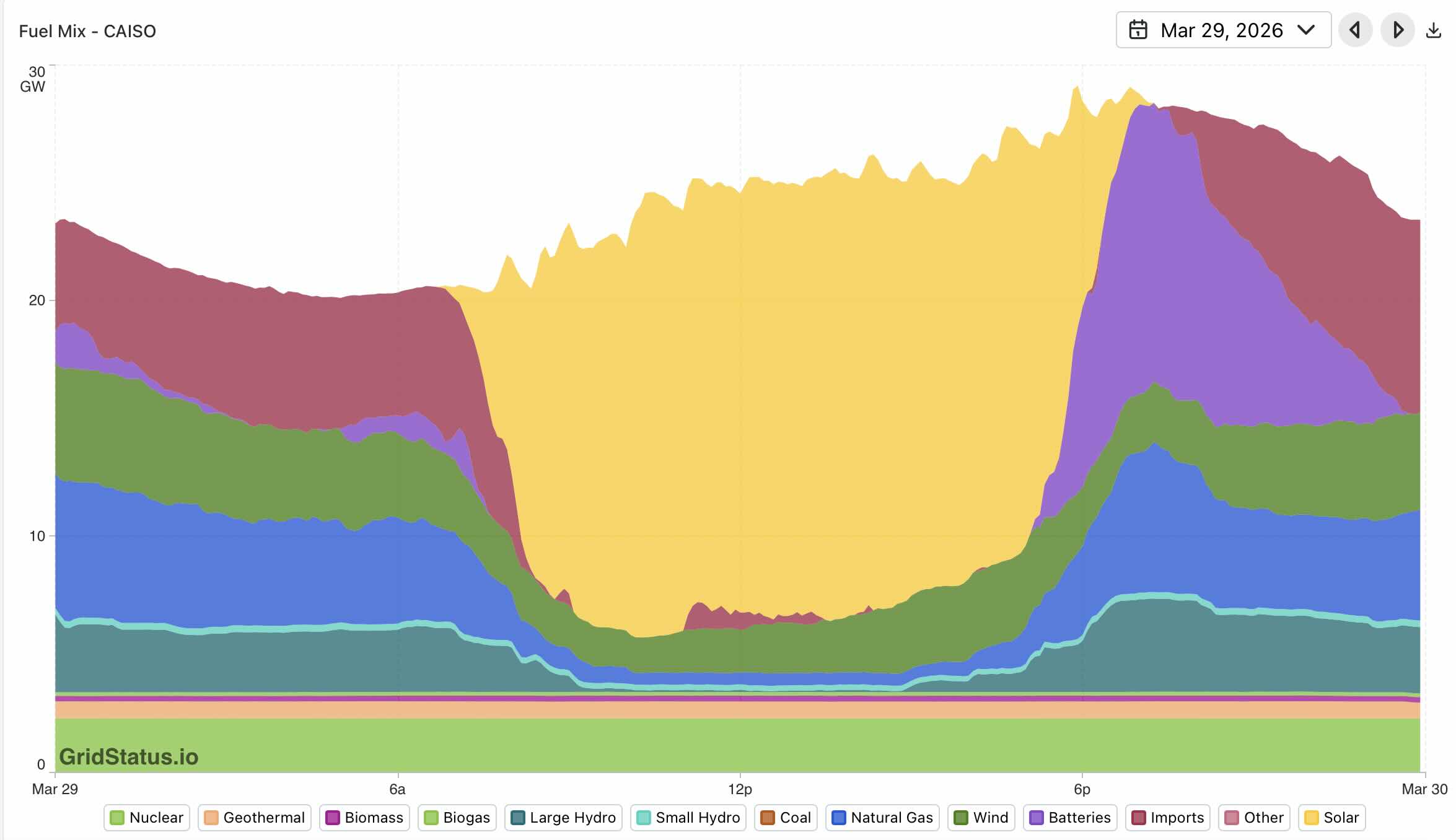
The fossil fuel economy is finished.
The only question is whether it manages to drag a lot of human civilization into it’s grave
I’m curious what the storage medium is. I didn’t see a breakdown in the article between grid scale storage and residential installs. It’d be pretty incredible if all of the demand was satisfied by power walls. Napkin math tells me that would require around 1.2 million installations.
It’s mostly utility scale installations.
This is good news. Solar is the way to go, if there’s a way to supply nighttime demand, and batteries are one solution. Solar panels are cheaper, more efficient, and last much longer than wind turbines. We really should replace wind turbines with solar panels and batteries, or some other method of storing the energy.
However, none of this seems to matter, if the ignorant masses keep getting duped by the billionaires.
Wind is still great. It’s worth diversifying to beat out fossil fuels
Indeed, in the UK (a notoriously windy place) wind currently far outpaces solar in terms of energy production and although it’s also variable, it works well in winter and at night.
During summer solar really shines (no pun intended), but wind absolutely rocks.
In California solar may be the way to go. In other areas with colder and cloudier climates wind is still very useful.
No, strategic renewables competition is counterproductive.
That’s wrong, wind can provide a steady energy source (you see that in the plot from the OP article), it is available during the night and, depending on geography, can match some energy demand quite well. For example, in coastal Northern Europe, there is lots of wind power in winter, when electricity is needed to power heat pumps.
Les mal meinen Kommentar im Kontext noch mal, ich glaub du hast da was durcheinander, das sage ich doch gar nicht
“fossil fuel economy is finished” is such a polarizing oversimplification. It will still have its uses for a long time.
Instead of dramatic statements, can we have more positive perspectives like “grid batteries really work, here’s some proof”
The problem with fossil fuel economy is that it depends on economies of scale. The less we use them, the more expensive it gets to use them. So it’s a feedback loop that might really accelerate the downfall of fossil fuels faster than expected.
As this war is showing fossil fuels only really have the advantage that they were cheap and the moment they lose that people start switching away rapidly
This.
Fossil fuels do have huge costs.
- Costs in terms of climate destruction
- Pollution and deaths from respiratory illness (think gas stoves)
- Loss of democracy - most large oil producing countries are not democracies. Putin’s Russia is only one of these.
- wars and war equipment, like Tomahawks and aircraft carriers
- bribe money
- lots of expensive advertising
The fossil fuel economy has their own feedback loops: Energetic ones, energy is needed to extract oil. And lots of cheap capital - this is why the 2008 financial crisis was linked with an oil price crises.
All this isn’t helped by the fact that most of the cheap oil that the world had, was already extracted. Oil extraction becomes more and more expensive.
Politically, it is a kind of power system that stabilizes itself. Like the old UDSSR’s system. You know what happened with the Sowjet bloc? it collapsed.
At some point, it gets too expensive. You see that, ironically, in Iran: Mass protests because in spite of the heaps of money moved, the population lacks proper food and income.
And in the US? Very few very rich people, and many which are barely scratching by. Fossil companies there now support an authoritarian state. Why? Because they don’t want that change that is inevitable in a democracy. Before these lose the game, they will smash the game table. It is similar to military companies financing fascist parties in Europe after WWI. After that catastrophic war, social democracy was on the rise, and people supported that another war was madness. These companies could not see how to make money in a peaceful cooperation of nations, so they tried to support fascism which strived to turn the clock back,
The thing is - at some point, these feedback loops come to a halt, and go into an reverse cycle.
The rising of cheap renewable energy and storage technology is only accelerating that. Oil extraction is getting more expensive, political and societal costs are rising (who wants to have a family member dying in Iran?), and the alternatives are becoming cheaper.
My take is that we will now witness a quick and swift change into another system. We will also see a huge re-adjustment of economical weights.
The way we organize and distribute power, in every sense of the word, will profoundly change and will be completely re-organized within no more than two decades. Possibly only ten years.
Fossil fuel industry will start wars and kill people to keep this from progressing. Don’t let your guard down.
The wars are only making it worse for them
Long term yes, since it encourages a switch from fossil fuels. Short term, it’s probably good for them. If you sell oil and take % cut. The cost doubles, your profit doubles! It also opens up more drilling that wasn’t worth the expense before.
It also opens up more drilling that wasn’t worth the expense before.
In theory yes. But while fracking is a more short-term activity, developing an oil field, let alone sub-sea oil fields is a very capital-intensive and time-consuming endeavour. It is possible that, due to the rapid transition to renewables, the time horizon that is left for earning with such developments, is not large enough to take the risk. Especially since the oil fields in the gulf states, which were already profitable, will be re-opened within a few years.
One can dream, but I’m pessimistic and see enough demand for a long while. Can’t even fully stop using coal yet.
Industrial developments typically have life times of twenty years. This is far longer than the time scale of the transition we can expect.
Also, the transition will be messy, not nice and tidy. In Germany, renewables have replaced nuclear first, only now they are replacing coal. The order might be different in the US, but then again things will become chaotic if due to cutting red tape a nuclear disaster happens in the US.
Things in the US will also be accelerated by the need to provide more power for AC in heat waves. That can go from an seemingly academic discussion to a question that is realized to be life-or-death quickly.
In Africa, solar panels are replacing firewood.
In Asia, countries are returning now to using coal as an emergency measure - but people know that this is only a temporary emergency solution.
South Asia also urgently needs power for AC, even more than the US.
China still builds coal plants, but they are designed as a fall-back to wind and solar, not as the backbone of supply. Which makes sense for them, because China has more coal than oil.
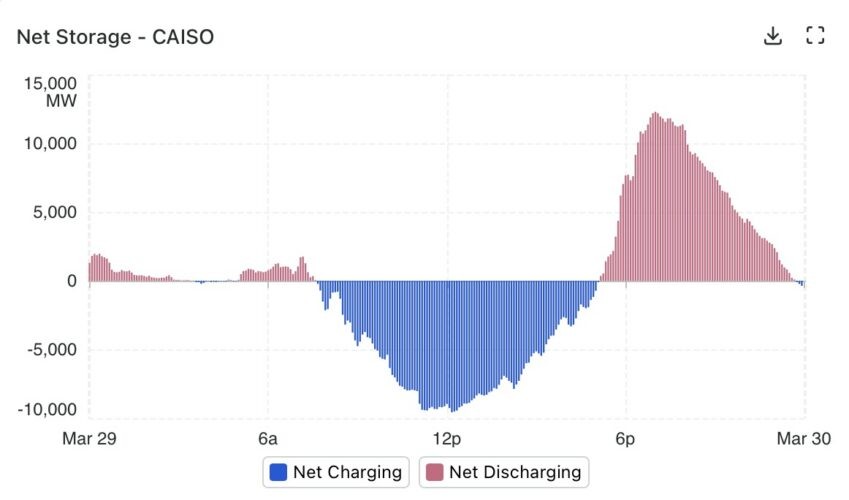
This is another view on what happened on Sunday in California. Batteries charged heavily throughout the day, soaking up the excess solar, approaching charging rates of 10 GW at times. In the evening, most of the output was centred on the early evening peak, but batteries supplied a significant share throughout the evening.
The biggest loser in this transition has been gas, with the share of battery storage staying at high levels throughout the evening peak. On Sunday, it stayed above 20 per cent of grid demand for almost four hours.
As Fulghum noted: “To put that kind of output during peak demand hours into perspective, it’s equivalent to the output from:
- 15-20 combined-cycle gas plants
- 6 Hoover dams
- More than the all-time peak demand of Portugal or Greece.”
Fuck these power companies that make this necessary. Fuck them. They drain our goddamn bank accounts and then force us into this. It’s not goddamn voluntary. We’re being forced to do this shit while they make RECORD PROFITS.
Fossil energy resources are finite, and they will become expensive in every sense of the word. I learned that in sixth grade, which was in 1979.
I’m in the UK but I’m less than 2 weeks my own solar and battery array is getting installed, can’t wait!
I’m on track to buy my first house this year and I’m genuinely looking forward to getting a solar setup. I’ve already built out a couple of small systems elsewhere, so I can’t wait to get my own.
Also interesting to see how imports help with those peaks. I imagine it must be things like hydropower from Oregon. Really shows how integrating these systems is important.
Yes, interconnected grids are cheaper than batteries, and they smooth out variations in space.