In Socialism, the means of production (aka the businesses) are owned by everybody. It is a completely different economical model to Capitalism, which is where the means of production are owned by individuals, like it currently is.
Just a couple of social policies do not make socialism.
Communism is considered the next step - a stateless and classless society without money.
Some will say it never existed since it would need to be worldwide, some will say its entirely possible within country borders. Many ways to interpret it and many more ways to disagree with what it means. However, most will agree that workers owning the means of production is part of it, but just workers owning the company they work for on its own generally isn’t enough to say its communism. We have companies which operate that way even today. Its a more broader term for how a whole society functions.
As I understand the terms (which may well be wrong), you’re correct and Denmark would be socialist. There might be some distance between “full” socialism wherein all public services are owned and controlled by the public (= the state), but the direction of social policies seems about right.
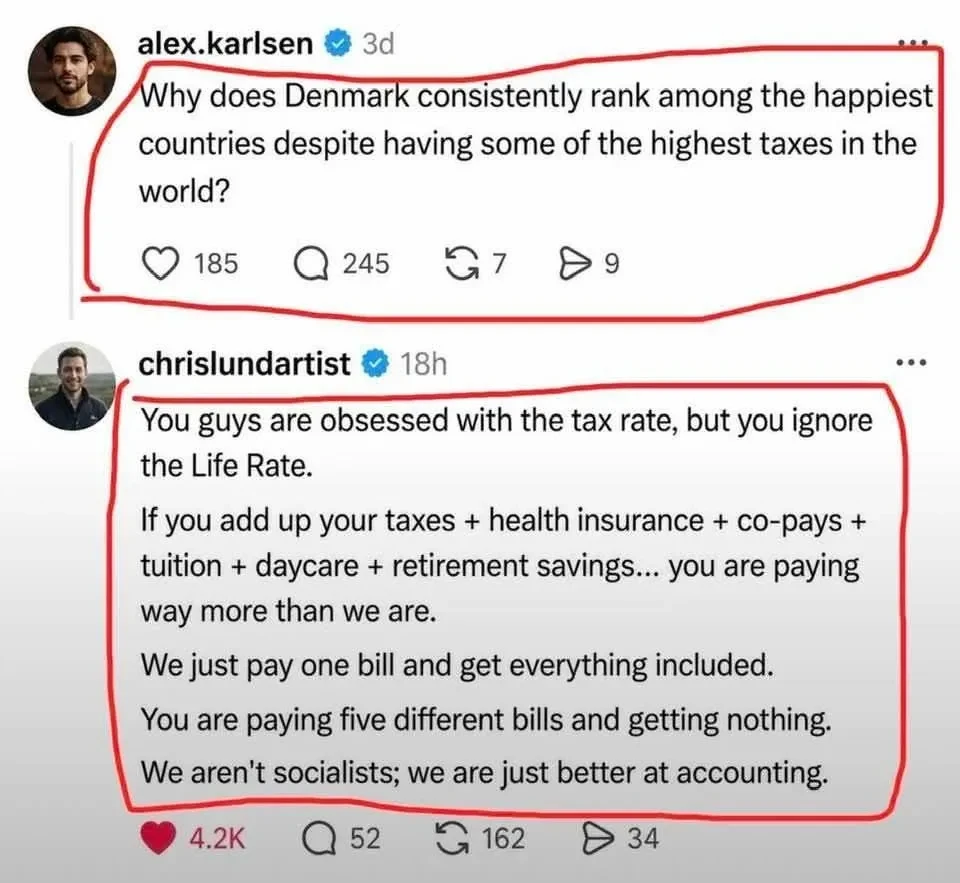
However, particularly in the US, that distinction has been smudged into one collective “evil leftist” scarecrow. I’d assume the person in the OP either doesn’t know or consciously accepts that fudging to make a case for why their system is beneficial rather than the “scary socialism”. Deflecting from the label to a descriptor (particularly in the context of profit-oriented mentalities, where “good accounting” would be desirable) dodges the preconceptions and propaganda attached to the former.
And ultimately, I think that’s more fruitful for explaining an ideology. Starting with a label that carries connotations primes expectations accordingly. Starting with and focusing on the benefits invites engaging with the topic and creates a different foundation for productive conversation.
What’s in a name? That which we call a rose
By any other name would smell as sweet.
So Romeo would, were he it not Romeo Socialism called,
Retain that dear perfection which he it owes
Without that title.
I’m not gonna suggest we stop calling socialism by that title, but I do see a case that aome discussions should be led with descriptions and arguments instead of terms that have been vilified to the point of stifling any reasonable discourse.


In Socialism, the means of production (aka the businesses) are owned by everybody. It is a completely different economical model to Capitalism, which is where the means of production are owned by individuals, like it currently is.
Just a couple of social policies do not make socialism.
I think workers owning the means of production is communism, not necessarily socialism. I’m not an expert though.
Communism is considered the next step - a stateless and classless society without money.
Some will say it never existed since it would need to be worldwide, some will say its entirely possible within country borders. Many ways to interpret it and many more ways to disagree with what it means. However, most will agree that workers owning the means of production is part of it, but just workers owning the company they work for on its own generally isn’t enough to say its communism. We have companies which operate that way even today. Its a more broader term for how a whole society functions.
As I understand the terms (which may well be wrong), you’re correct and Denmark would be socialist. There might be some distance between “full” socialism wherein all public services are owned and controlled by the public (= the state), but the direction of social policies seems about right.
However, particularly in the US, that distinction has been smudged into one collective “evil leftist” scarecrow. I’d assume the person in the OP either doesn’t know or consciously accepts that fudging to make a case for why their system is beneficial rather than the “scary socialism”. Deflecting from the label to a descriptor (particularly in the context of profit-oriented mentalities, where “good accounting” would be desirable) dodges the preconceptions and propaganda attached to the former.
And ultimately, I think that’s more fruitful for explaining an ideology. Starting with a label that carries connotations primes expectations accordingly. Starting with and focusing on the benefits invites engaging with the topic and creates a different foundation for productive conversation.
I’m not gonna suggest we stop calling socialism by that title, but I do see a case that aome discussions should be led with descriptions and arguments instead of terms that have been vilified to the point of stifling any reasonable discourse.
Denmark and most of Europe are social market economies i.e. capitalism + welfare state.
Gotcha. So comparatively closer to socialism than to communism, but not really socialism either.
Just capitalism with safety net.