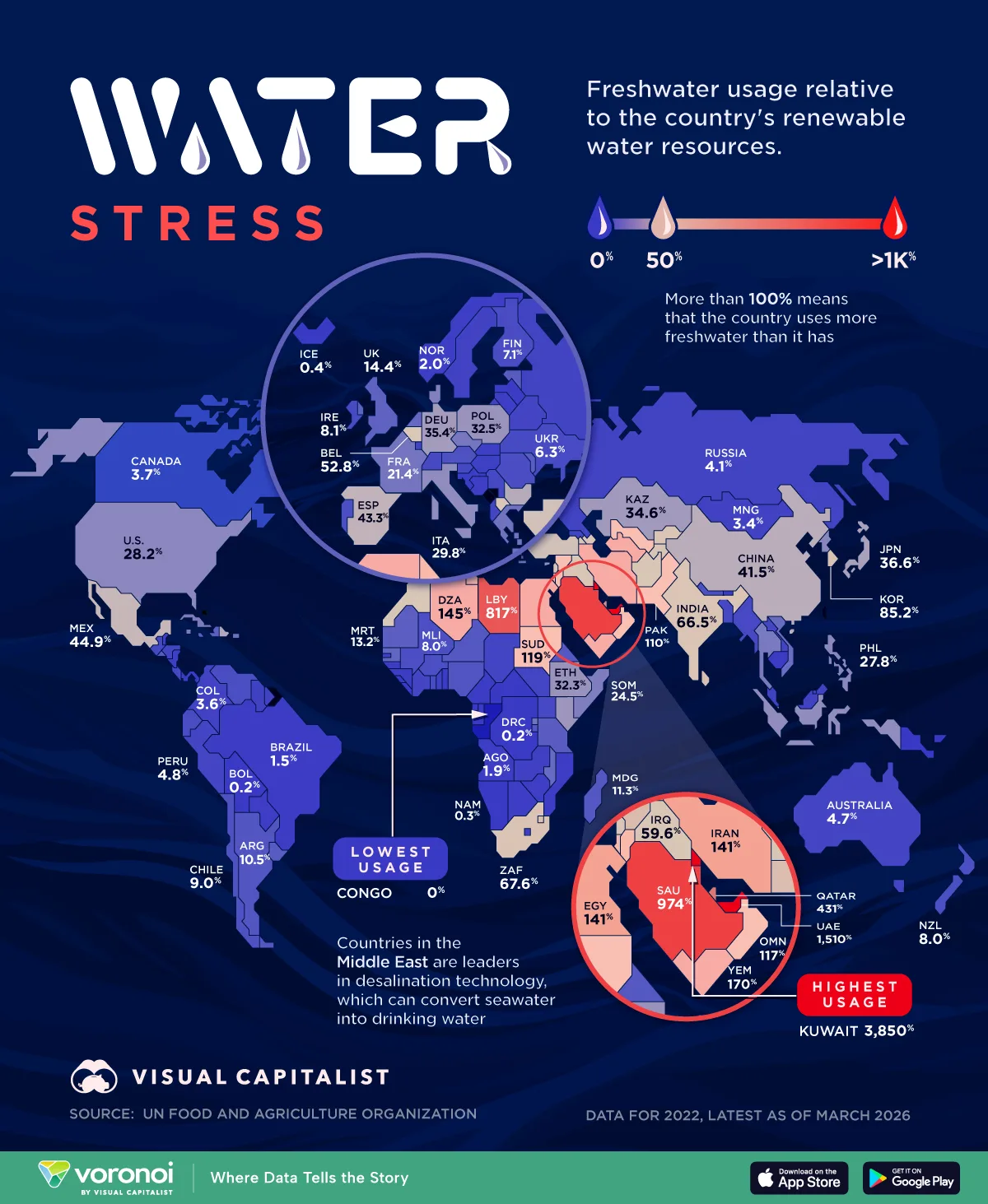
The Netherlands is more water stressed than…anywhere?! Freshwater management is insane here because we have so much of it.
I was going to comment the opposite.
The Netherlands is actually facing a fresh water crisis because unregulated farmers are pumping large amounts of water up from aquifers, causing them to pull in salt water from the sea which will poison the soil and make the aquifers undrinkable in the long term.
The rivers are too polluted to be safe for agriculture without expensive processing, but the process of fresh water filtering down through ground layers into aquifers makes it potable (long-term salinification notwithstanding).
I suspect the, er, “visual capitalist” disregarded those long-term externalities, or includes a theoretical capacity to clean (or even collect?) fresh water while not including the ability to desalinate salt water.
I also wonder how the graph accounts for water entering a country from another country. Most Dutch water management concerns the sea, which is not included in the graph, and rivers, which mostly come from other nations. If Germany consumed/redirected the Rhine, would that make the Netherlands appear more red on the map?
Also, Bangladesh and Nauru are both more “water stressed” than the Netherlands by your definition. Bangladesh regularly floods because it is a river delta in a monsoon region, and Nauru is an island nation that will be abandoned because sea levels are rising.
The UK is more water stressed than Australia ? That seems…unlikely ? Counter intuitive anyway
Two random guesses:
- The UK has been inhabited for longer and thus many more of its aquifers may have been tapped.
- Despite being fairly arid, Australia is just massive comparatively. In combination with number 1, it may have huge aquifers under uninhabited arid regions that are close to full.