Qurie GmbH has developed a heat pump that replaces traditional vapor-compression cycles with solid-state materials, potentially reaching over 70% theoretical efficiency and cutting energy use by up to 30%. Its patented heat-pipe-based design enables fast evaporation-condensation heat transfer without complex mechanics, achieving up to 20 Hz operation and aiming for compact, efficient cooling in sub-10 kW applications.
The path from here to a finished product is still ongoing. The next prototype will include around 20 segments, targeting a 20 Kelvin temperature span and approximately 100 W of cooling capacity. “The first commercial application will be control cabinet cooling and photonics or laser cooling,” Vogel stated. “These are niche markets where conventional refrigerants are often not suitable due to safety requirements such as ATEX explosion protection.”
“We believe the technology could ultimately be around 20% more efficient than current vapor compression systems in the 100 W to 10 kW range. However, scaling becomes more difficult, as our system scales linearly with material usage, whereas compressors benefit from more favorable scaling effects,” Vogel concluded. “We therefore do not target very large systems such as hotel air conditioning, but rather applications below 10 kW, including residential-scale heat pumps.”
If you already know how typical heat pumps work, said video could be summed up by this illustration:
Interesting additional tidbit: theoretical coefficient of power is around 20 for this tech vs 3 for what we use. Problem: heat is absorbed and dissipated at the same place, so you still do need something that circulates it around, even if you don’t need a compressor anymore.
As the video mentions, that’s not including a bunch of the required power to run an actual unit made to cool things like a fridge or air conditioner. The 3 COP number is inclusive of those extra power draws.



If you already know how typical heat pumps work, said video could be summed up by this illustration: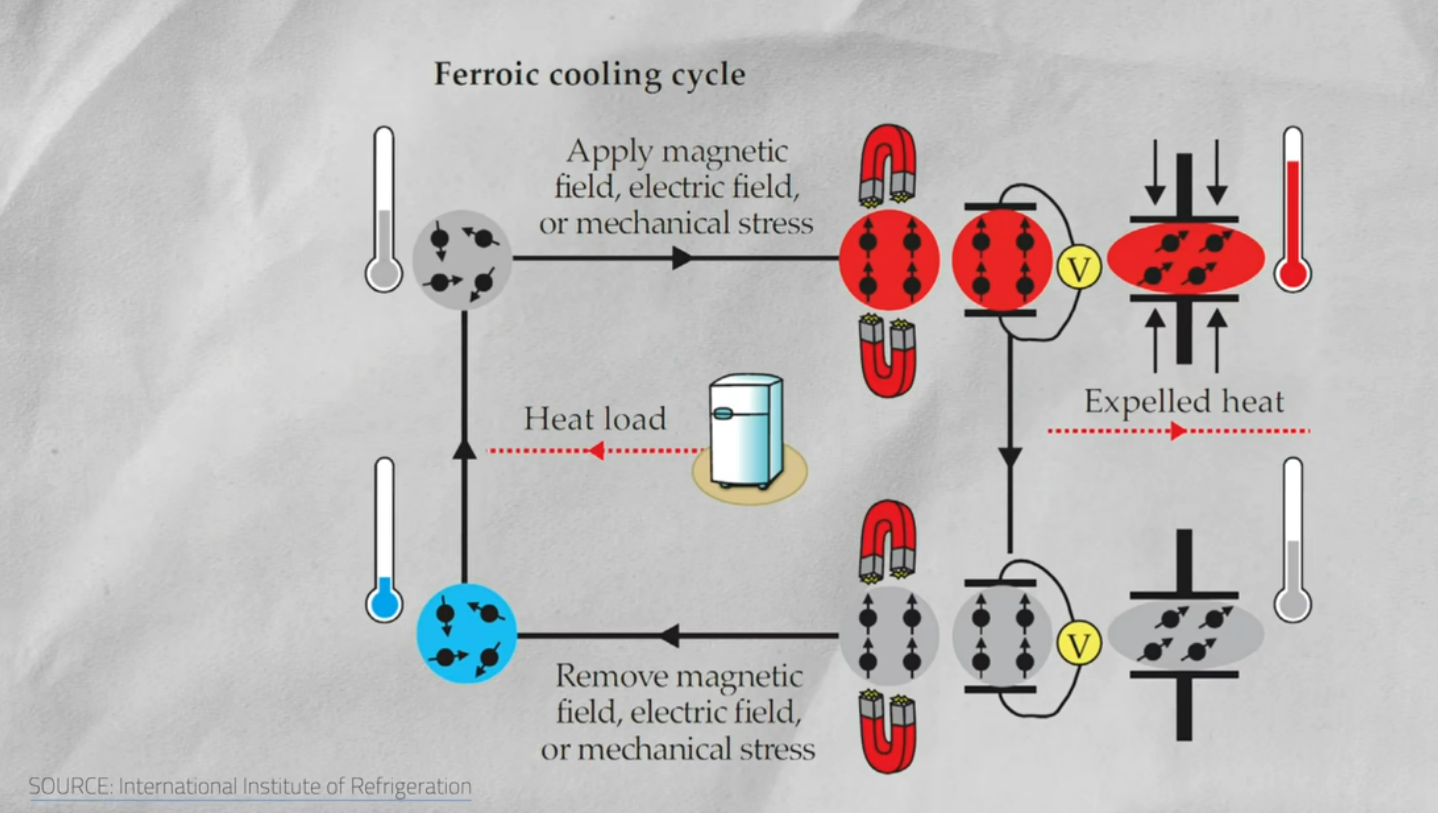
Interesting additional tidbit: theoretical coefficient of power is around 20 for this tech vs 3 for what we use. Problem: heat is absorbed and dissipated at the same place, so you still do need something that circulates it around, even if you don’t need a compressor anymore.
As the video mentions, that’s not including a bunch of the required power to run an actual unit made to cool things like a fridge or air conditioner. The 3 COP number is inclusive of those extra power draws.