Okay, so I have no idea about streaming services, but commercials on broadcast TV never had the volume increased but the compression.
(I love getting lost in details so apologies if any of this comes off condescending.) Compression works by making the quieter parts louder, without distorting the louder parts.
THINK of a SENTENCE where SOME of the WORDS are LOUD and OTHER words are QUIETER.
compression works by squishing down all the loud parts, then bringing everything back up to full volume, so the previous sentence would become:
THINK OF A SENTENCE WHERE SOME OF THE WORDS ARE LOUD AND OTHER WORDS ARE QUIETER.
Now, the loud parts didn’t become louder. What happened is that the quieter parts got louder. You lose the dynamic, but gain volume. If you think it would just be exhausting, you’re correct - even at low volumes, you can get a sense of ear fatigue when audio is heavily compressed.
Now, if you want to know why movies have quiet parts where you can’t hear shit and loud parts that are way louder, this is called dynamics. Artistically, you very much want this for the same reason you want quiet parts and loud parts in classical music. If everything is constantly loud, the dramatic moments won’t feel as impactful.
“But wait, I don’t enjoy that, I like having my TV at a reasonable volume!” Yup, me too. It’s fucking annoying. Mixing is done often on high quality speakers, loud volume, so you can get every detail. Most home setups dont have that nuance, and most people don’t care. Until execs can actually get proven that they’ll make more money by having consistent compression, you’re shit out of luck. You’ll probably have to get your own compression, either through software or hardware.
I thought you were going to get into lossy audio compression codecs. I don’t see ads but when I do my ears are like “what in the 128 Kbps MP3 is going on here?”
They do have parameters for TV ads though where they have to be under or in a range of loudness units, which accounts for that compression. I’m not sure if streaming services are bound by those same standards.


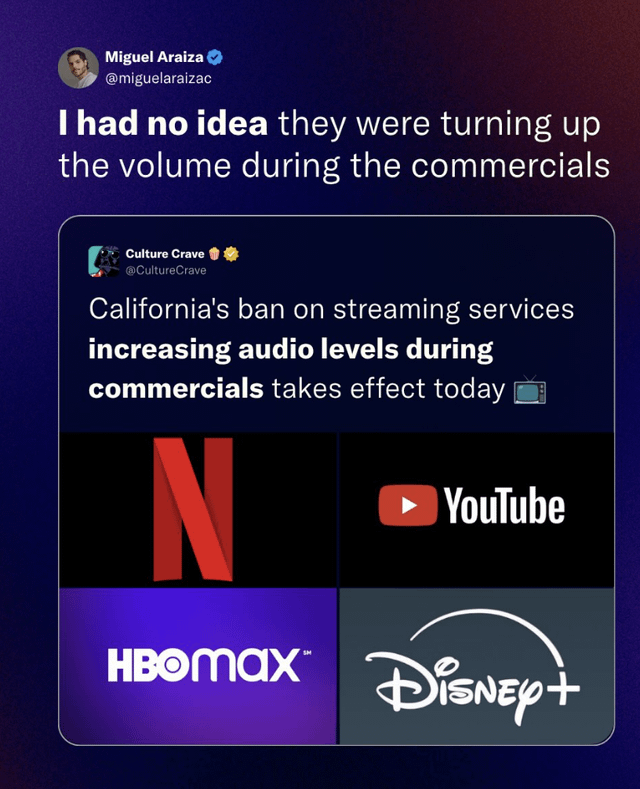
Okay, so I have no idea about streaming services, but commercials on broadcast TV never had the volume increased but the compression.
(I love getting lost in details so apologies if any of this comes off condescending.) Compression works by making the quieter parts louder, without distorting the louder parts.
THINK of a SENTENCE where SOME of the WORDS are LOUD and OTHER words are QUIETER.
compression works by squishing down all the loud parts, then bringing everything back up to full volume, so the previous sentence would become:
THINK OF A SENTENCE WHERE SOME OF THE WORDS ARE LOUD AND OTHER WORDS ARE QUIETER.
Now, the loud parts didn’t become louder. What happened is that the quieter parts got louder. You lose the dynamic, but gain volume. If you think it would just be exhausting, you’re correct - even at low volumes, you can get a sense of ear fatigue when audio is heavily compressed.
Now, if you want to know why movies have quiet parts where you can’t hear shit and loud parts that are way louder, this is called dynamics. Artistically, you very much want this for the same reason you want quiet parts and loud parts in classical music. If everything is constantly loud, the dramatic moments won’t feel as impactful.
“But wait, I don’t enjoy that, I like having my TV at a reasonable volume!” Yup, me too. It’s fucking annoying. Mixing is done often on high quality speakers, loud volume, so you can get every detail. Most home setups dont have that nuance, and most people don’t care. Until execs can actually get proven that they’ll make more money by having consistent compression, you’re shit out of luck. You’ll probably have to get your own compression, either through software or hardware.
Source: used to work in sound engineering.
I notice the sports betting commercials they engineer the sound to project the voices in loud environments like a bar. Its annoying as hell at home.
I thought you were going to get into lossy audio compression codecs. I don’t see ads but when I do my ears are like “what in the 128 Kbps MP3 is going on here?”
Audio compression is very different than file compression.
Maybe if the file compression is lossless but lossy file compression works by removing audio, no?
Completely different type of compression.
Oh okay let me just believe you with zero explanation.
People want Christopher Nolan films to sound like compressed commercials. 🤭
And Christopher Nolan wants his movies to sound good in theatres, not on TV’s.
Thank you for giving the explanation so I didn’t have to (used to work in broadcast TV including sound and station engineer)
This.
Source: i still work in sound engineering. This is all about compression. Commercials are brickwalled to shit.
They do have parameters for TV ads though where they have to be under or in a range of loudness units, which accounts for that compression. I’m not sure if streaming services are bound by those same standards.