False. All of it. Listening to your body is absolutely the treatment for ADHD. The post has confused listening with soothing. The problem is we aren’t taught how to listen and are stuck in an endless cycle of soothing overstimulated nerves.
This is a fantastic comment. Not necessarily because it’s universally true, but because it highlights variance in lived experience. There is a truth, but not the truth.
It highlights the reality that your body sends a demand for action, but it diminishes and oversimplifies the great challenge, the true mountain, of consciously mapping a instinctive solution, to a true need, to an optimal course of action to meet the need.
I want chips? Am I hungry? Is my blood sugar low? Am I experiencing an acute deficiency of saturated fats? Are my electrolytes imbalanced? Although it’s likely chips will solve it, there are several distinct underlying issues your body says chips are the solution. “Belly not full” is a gross oversimplification of what the issue may be, and without a full comprehension of the specific nature of the desire for chips, it’s possible and likely an attempt to outsmart yourself will end in failure.
And to be honest… “chips” is probably by a large margin the least complex. A cigarette. An energy drink. Alcohol. The depth of confusion of root cause on the alchemy your subconscious has been formulating for decades of trial and error, behind your back?
When Karen says to listen to your body, they are saying one thing. It is not the thing that ADHD people need to hear. They are not the same thing. That is OPs point, and they are right. The mechanics are fundamentally different. It isn’t wrong to highlight that Karen’s communicative intention is flatly based on a distinct experience which is not directly applicable in a meaningful way.
You’re saying “Listen to your body… and know that it is giving you a solution rather than telling you a problem, your goal is to bridge that gap”.
Karen isn’t false. OP isn’t false. You aren’t false. You’re all just expressing lived experience.
“Listen to your body” and “Listen to your brain” are two very different things. Your body isn’t going “hmm, we’re a bit low on salt, EAT CHIPS NOW”, it’s just reporting low sodium levels to your brain. It’s your brain taking that signal, interpreting it through the lens of your experiences and how you’ve trained it to think, and making the decision that you should seek out and devour chips. If you had never tried chips, your brain would not have that association, and would come up with a different approach to fixing your sodium levels.
That’s the difference between listening to your brain, which is screaming for the quick fix of junk food, and promising itself dopamine as a reward, and listening to your body so you can make a conscious decision on how to approach the situation. It’s not necessarily easy, and it takes practice, but it is possible.
Could you please give a couple of examples of what listening to your body looks like? I’m trying to understand myself better, I’ve existed as this body for 40+years and still don’t understand it. I was 30 before I realized hunger and thirst feel the same for me. Halp
I don’t know if it’ll help you, but I’ve noticed that my cravings for “sweet” are usually a sign of thirst. I don’t eat a lot of candy, so my go-to sweets are usually fruits. Fruits are hydrating, so it makes sense that the sensations got crossed somewhere in my nervous system. Now I sometimes drink water when I think I want something sweet and it works. (For me, at least. YMMV)
How do you know when you’re feeling hungry or thirsty? One option is just going about your day, busy busy, and all of a sudden you notice an intense sensation coming from your stomach. Right? Another option is when you are feeling anxious or angry or any other emotion, you use that as a cue to send a transmission to your stomach asking a question. Imagine you can somehow encode a signal that contains the data packet: “status?” and visualize it traveling down whatever pathway it wants from your brain to your stomach. Report back here the data that gets sent back.
I figure this is a low blood-sugar thing. I didn’t used to get tired when I was hungry, but being my 30s has meant a lot of changes around how my body reacts to hunger, including getting tired. Then if I go too long without eating, I end up in physical pain. Long gone are the days where I could skip breakfast, skip lunch, and survive just fine until after my school/work day.

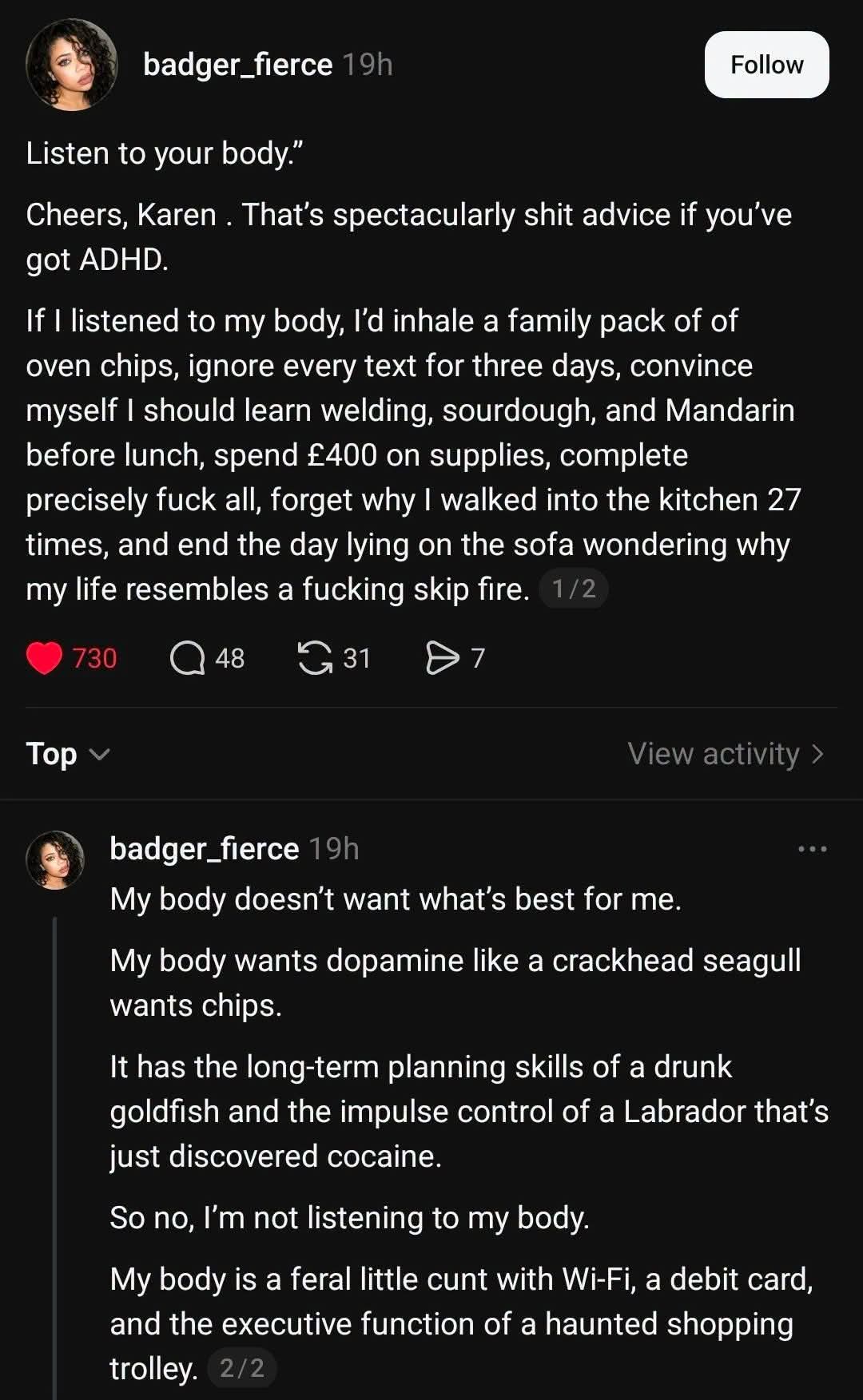
False. All of it. Listening to your body is absolutely the treatment for ADHD. The post has confused listening with soothing. The problem is we aren’t taught how to listen and are stuck in an endless cycle of soothing overstimulated nerves.
This is a fantastic comment. Not necessarily because it’s universally true, but because it highlights variance in lived experience. There is a truth, but not the truth.
It highlights the reality that your body sends a demand for action, but it diminishes and oversimplifies the great challenge, the true mountain, of consciously mapping a instinctive solution, to a true need, to an optimal course of action to meet the need.
I want chips? Am I hungry? Is my blood sugar low? Am I experiencing an acute deficiency of saturated fats? Are my electrolytes imbalanced? Although it’s likely chips will solve it, there are several distinct underlying issues your body says chips are the solution. “Belly not full” is a gross oversimplification of what the issue may be, and without a full comprehension of the specific nature of the desire for chips, it’s possible and likely an attempt to outsmart yourself will end in failure.
And to be honest… “chips” is probably by a large margin the least complex. A cigarette. An energy drink. Alcohol. The depth of confusion of root cause on the alchemy your subconscious has been formulating for decades of trial and error, behind your back?
When Karen says to listen to your body, they are saying one thing. It is not the thing that ADHD people need to hear. They are not the same thing. That is OPs point, and they are right. The mechanics are fundamentally different. It isn’t wrong to highlight that Karen’s communicative intention is flatly based on a distinct experience which is not directly applicable in a meaningful way.
You’re saying “Listen to your body… and know that it is giving you a solution rather than telling you a problem, your goal is to bridge that gap”.
Karen isn’t false. OP isn’t false. You aren’t false. You’re all just expressing lived experience.
“Listen to your body” and “Listen to your brain” are two very different things. Your body isn’t going “hmm, we’re a bit low on salt, EAT CHIPS NOW”, it’s just reporting low sodium levels to your brain. It’s your brain taking that signal, interpreting it through the lens of your experiences and how you’ve trained it to think, and making the decision that you should seek out and devour chips. If you had never tried chips, your brain would not have that association, and would come up with a different approach to fixing your sodium levels.
That’s the difference between listening to your brain, which is screaming for the quick fix of junk food, and promising itself dopamine as a reward, and listening to your body so you can make a conscious decision on how to approach the situation. It’s not necessarily easy, and it takes practice, but it is possible.
Could you please give a couple of examples of what listening to your body looks like? I’m trying to understand myself better, I’ve existed as this body for 40+years and still don’t understand it. I was 30 before I realized hunger and thirst feel the same for me. Halp
I don’t know if it’ll help you, but I’ve noticed that my cravings for “sweet” are usually a sign of thirst. I don’t eat a lot of candy, so my go-to sweets are usually fruits. Fruits are hydrating, so it makes sense that the sensations got crossed somewhere in my nervous system. Now I sometimes drink water when I think I want something sweet and it works. (For me, at least. YMMV)
How do you know when you’re feeling hungry or thirsty? One option is just going about your day, busy busy, and all of a sudden you notice an intense sensation coming from your stomach. Right? Another option is when you are feeling anxious or angry or any other emotion, you use that as a cue to send a transmission to your stomach asking a question. Imagine you can somehow encode a signal that contains the data packet: “status?” and visualize it traveling down whatever pathway it wants from your brain to your stomach. Report back here the data that gets sent back.
Hunger thirst and tiredness can all feel the same. “I WANT SUMFING!” (I don’t understand my cat when she says this either)
I figure this is a low blood-sugar thing. I didn’t used to get tired when I was hungry, but being my 30s has meant a lot of changes around how my body reacts to hunger, including getting tired. Then if I go too long without eating, I end up in physical pain. Long gone are the days where I could skip breakfast, skip lunch, and survive just fine until after my school/work day.
Sigh.
Mindfulness
I relate. The amount of times I’ve said “am I hungry or thirsty?… hmm, don’t know.” And then done nothing about either one.