

For years it’s bothered me, and the explanation still annoys me,
I can’t find a picture of just two bright spots after its being observed.
So why can’t we get a video of non observation giving the wave form then, begin observing and see it shift to two bright spots?
I have no qualifications to talk about any of this but could it be because a photon is massless they just kinda always move through on an odd angle?
They can also do it with electrons, could that just be electrons somehow passing a charge off to the slit then pushing them around?
My current understanding is that the reason we can’t see the two bright spots rather then the wave is its just a thought experiment rather then an observable phenomenon.
I’m dont expect answers really but it just kinda drives me mad at night
Here’s a kind old Dutch guy explaining. 5 minutes.
~But there is a long follow up video with waay more details that goes deep into the physics.~
The double-slit experiment is a staple of pop-science physics, but from a pedagogical perspective it’s not a great illustration. This is because it combines two, largely independent aspects:
-
Wave interference, which occurs in both classical and quantum contexts.
-
Wave function collapse, which occurs only in quantum mechanics.
I would recommend trying to understand 1 and 2 separately; the combination thereof into the double-slit experiment is quite trivial, once you understand the underlying concepts. What’s especially important to keep in mind is that the double-slit experiment is not “special” in a broader sense, so any kind of question like “but what if detector such and such, what if the particles are so and so” etc. misses the mark if it doesn’t touch on these broader, fundamental concepts.
So here’s what you should do. First, try to understand classical wave interference. There is no essential difference between this and its quantum analog. Secondly, try and get some intuition for the Born rule, and under what conditions it is applied. Some basic mathematical skills are very helpful in this regard. Elementary quantum mechanics does not involve very deep mathematics, a college freshman level suffices.
-
You’re missingerpreting what the 2 slit experiment is.
Have a wall with two slits and a white wall in front of it, fire a single paint ball at that wall. Observe where the ball hit the wall. Now fire another. Now another. Keep going until a pattern emerges.
This is what you expect from paint balls or grains of sand:

That’s an extreme representation, in reality some balls will hit in different locations, but that’s the image you expect to be formed by the majority of the hits.
However when you fire photons or electrons, the image you get is different, like so:

That second image sort of makes sense if you were firing millions of particles at the same time, because ones going left, and ones going right would hit each other and fall before reaching the wall, thus interfering with one another. But that’s not the case, you’re firing a single electron/photon at a time (and only getting a single marker on the wall behind).
This is an actual image of the experiment result:

As you can see, it’s not perfect, but it behaves as a wave (i.e. as a bunch of particles colliding with one another), even though you’re only sending one at a time. The only explanation is that the particle went through both slits and interacted with itself.
So someone thought, but what if we measured which slit it goes through? Then we can trace where each ball came through and get a better idea. The moment they turn the detector on the particles behave like paintballs:

That’s what makes this weird, if you trace their paths they behave like particles, if you don’t they behave as waves.
Great explanation.
Op’s question still stands, is there no comparison of the detector turning on and the pattern visibly changing? If the detector can’t detect photons fast enough for them to be visible perhaps filming with extremely high exposures could demonstrate it?
First of all you can’t film a photon passing by, that’s the equivalent of asking a machine that captures tennis balls to tell you when one flew by, in short cameras only work when photons hit it, you can’t see a photon unless it hits the camera and if it did it’s not taking part on the experiment. Similarly for electrons if a photon hit the electron to allow you to record it you’ve altered the experiment dramatically, someone else here made a comparison that measuring an electron with light is like trying to measure a ping pong ball with a machine gun and that is very accurate here.
I’m not understanding the question though, the pattern is the result of a statistics applied over a long time, each individual electron/photon behaves normally regardless, it’s only when averaging thousands of them that you notice the pattern changes. Think about measuring how good a sharpshooter is, you can’t measure that with a single shot as it could have been a lucky/unlucky break, but over dozens or hundreds of shots you can get a much better idea of how accurate that shooter is. Similarly turning the detector on/off doesn’t change anything instantly, the photon/electron you shot before and the one you shoot after behave roughly the same, but the average of the thousand ones you sent before behaves differently from the average of the thousand ones you sent after.
You can do the undetected double slit experiment with a normal laser and see the pattern with plain eyes / record it with a camera, no need for statistics. One of op’s questions was why the same wasn’t the case for the observed case.
The way the double slit experiment is ran with photons is using polarized filters on each slit. Here you go, a quick Google search shows that this is how the experiment looks with the filters off/on

As you can see there the observed version is boring, hence why people never bother to show it.
You can’t measure a particle using a tool with a sensor/medium that has a larger wavelength (grains in film, pixels on a sensor) than the particle. Film and photosensors react to light (mostly), the particle that transmits light is a photon, which is larger than an electron. Electrons are effectively invisible.
Imagine you have a ball that’s 1cm diameter, and you have a photosensor with a resolution of 5 cm. If you take a picture of the space the ball is occupying, it would be part of the background, indistinguishable.
Or if it’s a motion-capturing sensor that could take images every second. If the ball moves through the frame faster than a second, it won’t appear.
Now back to the film/photo sensor. They both work by absorbing energy from photons - showing that any measurement requires engaging with the energy of what’s being measured.
At the macroscopic scale that tends to not disturb what’s being measured - but the subatomic scale requires measurements using energies at about the same magnitude of what’s being measured, so it alters the system.
(I am NOT a physicist, so welcome any corrections by those who understand it better).
Maybe photons are shy
How does that detector work? How is capable of detecting individual photons without absorbing them? Wasn’t that part a thought experiment?
The traditional experiment is with electrons, for photons you do something different, you place a polarizing filter in front of each slit, one horizontal and one vertical. Think on polarized filters like grates, and the photons are pencils, a pencil thrown vertically will pass through a vertical grate but clash against a horizontal one .Therefore you can know which slit a specific photon went through by adjusting the measure to pick only certain angles. If you select any of the specific angles for one slit you get no interference, as would be expected since in theory photons that went through one slit can’t go through the other. However if you measure an angle in between both you get interference patterns, so you’re having pencils passing both vertically and horizontally through the slits.
trace their paths they behave like particles,
It’s not so weird in that for the device to measure which path it has to interact with the photon.
Like trying to measure where a ping pong ball will roll on a table when your only method of looking at it is to shoot the ball with a machine gun and then examine the bullets. Of course the bullets are going to knock the ball of its original path.
Like trying to measure where a ping pong ball will roll on a table when your only method of looking at it is to shoot the ball with a machine gun and then examine the bullets.
But that’s NOT what happens. You can predict the influence your measurement would have. It wouldn’t, normally cause this effect. You might expect the grouping to bend, or distort, or otherwise be distorted by the measurement.
But that’s not what happens. Measuring it has the effect of “turning a wave into a particle”. That shouldn’t happen, and it makes absolutely no sense in classical physics.
We’ve repeated the double slit with really really massive molecules, like 1000+ atoms per molecule, and tinier measurements, and it still has the same effect. Think of it as measuring a wrecking ball with a peashooter, yes, you should expect an effect, but not this.
It’s not a transfer of energy, it’s the act of measuring/interacting itself that causes it. And that’s super fucking weird.
There’s a saying in Quantum Physics that is “shut up and calculate”, because so many things go against your common sense, and only make sense in the maths.
Yes, you are absolutely correct, and that does help explain where the observer effect comes from, there’s no way to observe without interact and that’s something I think most people miss. I had a teacher that gave a very similar example to yours, he said “imagine your way of seeing the world is by throwing tennis balls in front of you and measure the time it takes them to come back, you could easily measure a chair like this, now try to measure the position of a ping-pong ball”.
That being said, the measurements interference alone doesn’t make the wave behave like a particle, you should get the same interference pattern only slightly shifted by your measurement equipment interference. For example, if you use a magnet to measure the electrical field generated by the moving electron, that would pull the electron towards/away from the magnet, but it should still interact with itself. What’s weird is that by measuring it on one slit it ceases to interact with the version from the other slit (since it never went there sort of speak).
They’ve run the double slit experiment with really really heavy molecules as well (heavy for a molecule, that is) and the same thing occurs. It doesn’t just happen with photons.
Didn’t knew that, that’s very interesting, I wonder if we will ever reach a hard limit on size/weight for it, in theory it’s just less likely to happen with larger things, but we might eventually figure out a way to tweak those odds.
What’s weird is that by measuring it on one slit it ceases to interact with the version from the other slit (since it never went there sort of speak).
I like Feynman’s explanation in QED. Each particle has clock (phase). This causes interference patterns. If you measure it at the slit, it means one photon hit a detector in the slit and a new photon was emitted out the slit so the clock (phase) is reset.
And thus the fundamental limitation of quantum mechanics: What is a measurement?
Great explanation
Because observation in quantum mechanics doesn’t mean “some human looked at the pattern”, but rather “some.device was used to measure the particles”
It’s probably the worst communicated scientific assertion in all pop science.
I think one of the reasons is that they usually try it with individual particles. So there really isn’t one bright spot to show, only a photo paper or similar with accumulated spots.
not only can we see the 2 slit exposures, we can see 3 when they pushed it to 3 slits
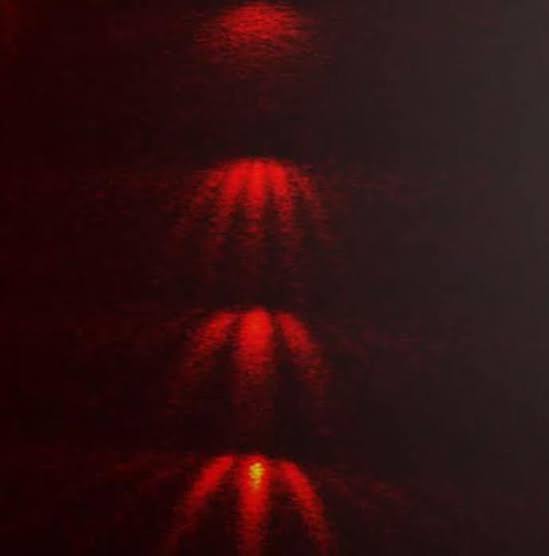
But still a wave form
That’s just it though - a wave pattern emerges even when one particle at a time was “shot” from an electron gun, it hit the phosphorus screen. Then another shot. Over time a wave interference pattern emerges when you’d expect a pattern of single particles.
Subatomic particles behave differently than macroscopic objects.


