They are? Unless you mean to an arbitrary tip amount like 20%. Businesses are required to pay servers minimum wage if tips don’t make it. It’s still super scummy and they should pay living wages by default, but they can’t just not pay people.
A specific tip amount, yeah. Minimum wage is pretty low compared to 20% tips. Fully agree that just having a living wage across the board would be the best solution, though.
That minimum wage for servers can be as low as $2.13 an hour, depending on the state. The amount and how it is applied varies widely and all of the minimums are pretty low. That server needs every last dollar.
You are misunderstanding. A server must be paid $2.13 an hour (depending on state) plus tips.
If however the tips do not raise the server to the federal minimum wage of $7.25 (or the state’s minimum wage if required) then the business must pay the difference.
Basically if a server goes in for a 4 hour shift and doesn’t have a single customer/tip they must at minimum be paid by the company $7.25 an hour.
Funnily enough this is stated a couple of paragraphs down in your very source:
If an employee’s tips combined with the employer’s direct (or cash) wages do not equal the minimum hourly wage of $7.25 per hour in each workweek, the employer must make up the difference.
No, I am not misunderstanding. There are a number of exceptions: hotel restaurants, bartenders, minors, students, people in Montana working for a “business not covered by the Fair Labor Standards Act with gross annual sales of $110,000 or less.” That last one you’re only guaranteed $4.00 an hour.
That’s why I linked the table.
That bit you quoted does not apply to all situations, nor does it reflect this provision at the bottom:
Some states set subminimum rates for minors and/or students or exempt them from coverage or have a training wage for new hires. …Such differential provisions are not displayed in this table.
There are a number of exceptions: hotel restaurants, bartenders, minors, students
That is incorrect all of these employees are subject to the Fair Labor Standard act. Everything previously stated applies.
business not covered by the Fair Labor Standards Act with gross annual sales of $110,000 or less
So that’s an interesting one, because Montana is even stricter than the what is laid out as an exemption federally. Which is a buisnesses that makes less than 500,000. But those buisnesses also cannot engage in Interstate Commerce per federal law. In the modern world it is nearly impossible to have a buisness making any amount money that does not engage in some form of Interstate Commerce. So functionally that exemption is meaningless.
You did skip a few types of employees that are actually exempt like movie theater employees. Originally they were exempted from overtime and federal minimum wage provision of the FLSA. However, this has since been changed and now they are only exempt from overtime regulations.
Now to your last part which is the crux of your misunderstanding
Some states set subminimum rates for minors and/or students or exempt them from coverage or have a training wage for new hires. …Such differential provisions are not displayed in this table.
This only applies to the wage they receive before tips. Still per federal law they must make at least $7.25 an hour after tips.
What this paragraph is saying is that a state may have a minimum tipped wage of $4.00 per hour, but a provision for students that sets it to $3.00 per hour. The table does not reflect this.
An individual state law cannot supersede federal law. So these employees still must make a minimum of $7.25 an hour. That is base tipped minimum wage plus tips. If the minimum wage, be it 3 or 4 dollars to use the example, and the person’s tips add up to less than 7.25 an hour then the buisnesses must cover the difference. Unless the buisness is exempt, which is functionally impossible for a restaurant.
This is all to say yes, all servers do indeed make at least the federal minimum wage of $7.25 an hour. If they are not making at least that they should contact the department of labor for unpaid wages.
All employers covered by the FLSA may pay eligible employees the youth minimum wage, unless prohibited by State or local law. Where a State or local law requires payment of a minimum wage higher than $4.25 an hour and makes no exception for employees under age 20, the higher State or local minimum wage standard would apply.
Almost everything you said was error filled, and you provided no material proofs for it, because you can’t: links don’t exist for what you pull out of your ass.
But it’s what you said it in defense of that is truly shitty. No surprise, then, that it requires lies to defend.
Which is a buisnesses that makes less than 500,000. But those buisnesses also cannot engage in Interstate Commerce per federal law. In the modern world it is nearly impossible to have a buisness making any amount money that does not engage in some form of Interstate Commerce. So functionally that exemption is meaningless.
I am well aware of what that means. I think that you are not. Check out what the DoL has to say about businesses and individuals not covered by FLSA: there are plenty of businesses that do not meet the standards but have employees that do, for example.
You are really reaching when you insist – incorrectly – that Montana’s exception has no real world meaning. I assure you that exception was very specifically placed in the law for a real world business’ benefit, and that that business had pull in the state capitol or it would not have been added, just as the FLSA itself provides for those exceptions to be made by the states.
If you can’t be bothered to educate yourself on what “interstate commerce” means in the federal legal sense, that’s fine by me because I’ve provided links for all of my assertions, unlike you: people can read them for themselves.
The FLSA has carve outs for various kinds of employees, and while minors are covered, they are not covered as adults are:
The 1996 Amendments to the FLSA allow employers to pay a youth minimum wage of not less than $4.25 an hour to employees who are under 20 years of age during the first 90 consecutive calendar days after initial employment. The law contains certain protections for employees that prohibit employers from displacing any employee in order to hire someone at the youth minimum wage. – from the DoL page linked below
In addition, only a handful of states actually ban subminimum pay for minors, requiring by law full minimum wage. You wrote,
An individual state law cannot supersede federal law.
That is where you are flat out wrong. When it comes to minors and other special categories of workers, they can and do.
State law prevails: If state law is more restrictive than federal (higher youth wage or no youth wage), you must follow state law.
Again, that’s why I linked the table. It’s a complex maze of laws and conditions. And I didn’t miss this. You wrote,
You did skip a few types of employees that are actually exempt like movie theater employees.
That’s because I did not expect someone to fight so hard, with such incorrect and easily disproved assumptions, in defense of such a shitty principle: not paying servers a living wage.


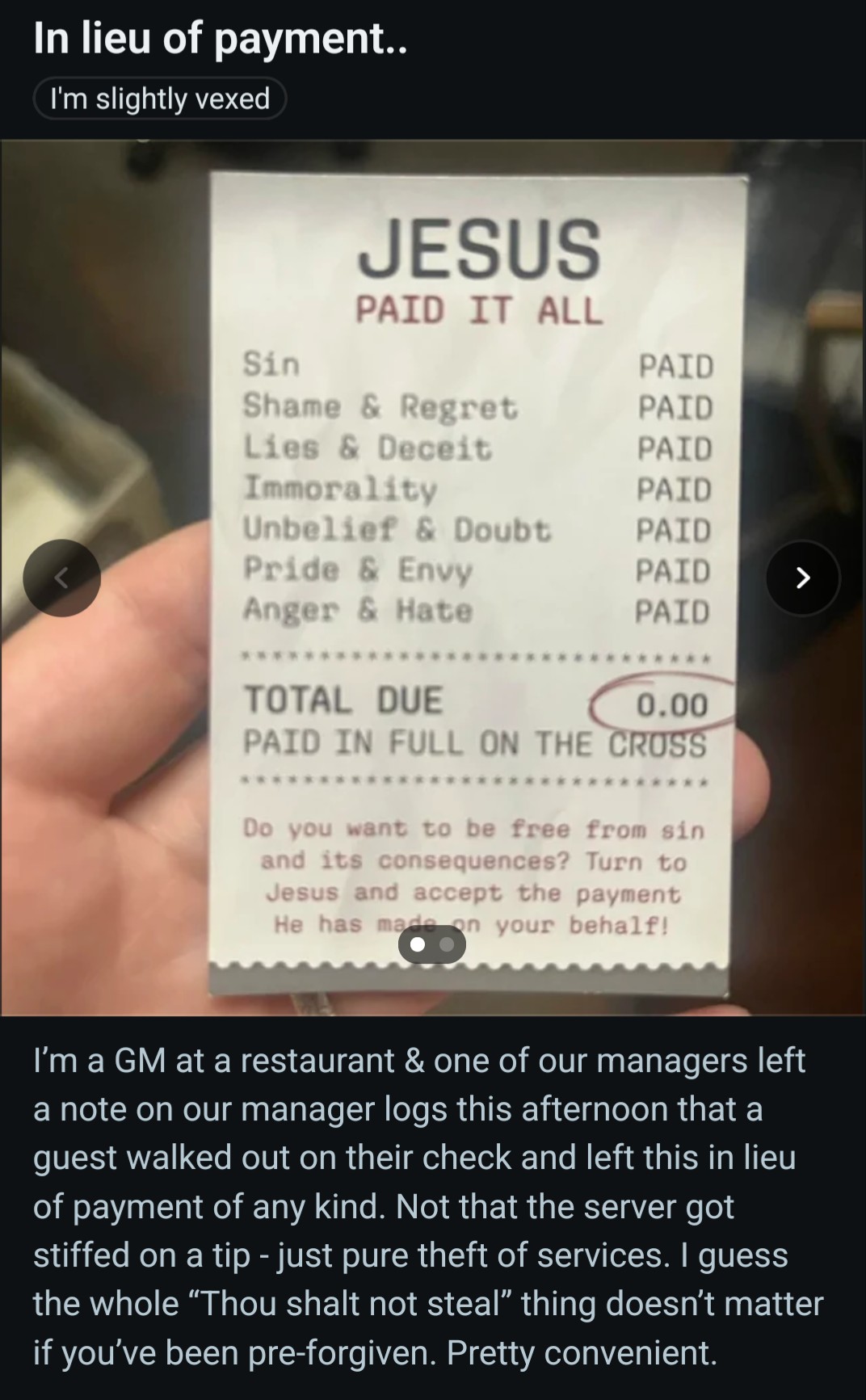
Yeah, if owners were required to cover the difference when waiters get stiffed or under-tipped, I bet things would change pretty quickly.
They are? Unless you mean to an arbitrary tip amount like 20%. Businesses are required to pay servers minimum wage if tips don’t make it. It’s still super scummy and they should pay living wages by default, but they can’t just not pay people.
A specific tip amount, yeah. Minimum wage is pretty low compared to 20% tips. Fully agree that just having a living wage across the board would be the best solution, though.
That minimum wage for servers can be as low as $2.13 an hour, depending on the state. The amount and how it is applied varies widely and all of the minimums are pretty low. That server needs every last dollar.
You are misunderstanding. A server must be paid $2.13 an hour (depending on state) plus tips.
If however the tips do not raise the server to the federal minimum wage of $7.25 (or the state’s minimum wage if required) then the business must pay the difference.
Basically if a server goes in for a 4 hour shift and doesn’t have a single customer/tip they must at minimum be paid by the company $7.25 an hour.
Funnily enough this is stated a couple of paragraphs down in your very source:
No, I am not misunderstanding. There are a number of exceptions: hotel restaurants, bartenders, minors, students, people in Montana working for a “business not covered by the Fair Labor Standards Act with gross annual sales of $110,000 or less.” That last one you’re only guaranteed $4.00 an hour.
That’s why I linked the table.
That bit you quoted does not apply to all situations, nor does it reflect this provision at the bottom:
Here’s another source that gives it from another viewpoint. Whichever way you turn it, server pay is abysmally low. They need every dollar. And no, not all of them even make minimum wage.
That is incorrect all of these employees are subject to the Fair Labor Standard act. Everything previously stated applies.
So that’s an interesting one, because Montana is even stricter than the what is laid out as an exemption federally. Which is a buisnesses that makes less than 500,000. But those buisnesses also cannot engage in Interstate Commerce per federal law. In the modern world it is nearly impossible to have a buisness making any amount money that does not engage in some form of Interstate Commerce. So functionally that exemption is meaningless.
You did skip a few types of employees that are actually exempt like movie theater employees. Originally they were exempted from overtime and federal minimum wage provision of the FLSA. However, this has since been changed and now they are only exempt from overtime regulations.
Now to your last part which is the crux of your misunderstanding
This only applies to the wage they receive before tips. Still per federal law they must make at least $7.25 an hour after tips.
What this paragraph is saying is that a state may have a minimum tipped wage of $4.00 per hour, but a provision for students that sets it to $3.00 per hour. The table does not reflect this.
An individual state law cannot supersede federal law. So these employees still must make a minimum of $7.25 an hour. That is base tipped minimum wage plus tips. If the minimum wage, be it 3 or 4 dollars to use the example, and the person’s tips add up to less than 7.25 an hour then the buisnesses must cover the difference. Unless the buisness is exempt, which is functionally impossible for a restaurant.
This is all to say yes, all servers do indeed make at least the federal minimum wage of $7.25 an hour. If they are not making at least that they should contact the department of labor for unpaid wages.
Just in case you missed it: (emphases mine)
I did indeed miss that one, so you got 1 out of 4
Almost everything you said was error filled, and you provided no material proofs for it, because you can’t: links don’t exist for what you pull out of your ass.
But it’s what you said it in defense of that is truly shitty. No surprise, then, that it requires lies to defend.
You wrote,
I am well aware of what that means. I think that you are not. Check out what the DoL has to say about businesses and individuals not covered by FLSA: there are plenty of businesses that do not meet the standards but have employees that do, for example.
You are really reaching when you insist – incorrectly – that Montana’s exception has no real world meaning. I assure you that exception was very specifically placed in the law for a real world business’ benefit, and that that business had pull in the state capitol or it would not have been added, just as the FLSA itself provides for those exceptions to be made by the states.
If you can’t be bothered to educate yourself on what “interstate commerce” means in the federal legal sense, that’s fine by me because I’ve provided links for all of my assertions, unlike you: people can read them for themselves.
The FLSA has carve outs for various kinds of employees, and while minors are covered, they are not covered as adults are:
In addition, only a handful of states actually ban subminimum pay for minors, requiring by law full minimum wage. You wrote,
That is where you are flat out wrong. When it comes to minors and other special categories of workers, they can and do.
Here’s the DoL page on that, you should read it:
Fact Sheet #32: Youth Minimum Wage - Fair Labor Standards Act
Here’s another page that lays out what that means for tipped minors. Quoting from further down in the page:
Again, that’s why I linked the table. It’s a complex maze of laws and conditions. And I didn’t miss this. You wrote,
That’s because I did not expect someone to fight so hard, with such incorrect and easily disproved assumptions, in defense of such a shitty principle: not paying servers a living wage.