Many countries include ‘Democratic’ or ‘People’s’ in their names, even though they are not democratic and do not serve their people. Examples: Democratic People’s Republic of Korea Lao People’s Democratic Republic People’s Democratic Republic of Algeria Democratic Republic of the Congo And German Democratic Republic (East Side) in 1949–1990. None of these states are democratic, power and wealth are concentrated in the hands of a small ruling elite. Who are they fooling with these names?
Can’t believe you’d ask this question and leave out the People’s Republic of China.
Tbf I’m not excusing the CCP but they seem to be a lot better about practicing democracy / voting in council and ability to advance in politics than the others on the list, as long as your Han Chinese. Still authoritarian though.
I’m Chinese. There is a difference between what Chinese people call democracy and what traditional Western political philosophy calls democracy.
In China, democracy (民主) means government which works for the benefit of the people.
As it is defined in Western political philosophy, democracy means that the people can control the composition and decisions of their government.
This means that a benevolent dictatorship which furthers the interest of the people qualifies as democratic under the Chinese definition, even though it obviously wouldn’t in the Western definition. Conversely, a government which works only for the upper class and a select elite isn’t democratic under the Chinese definition, but it could be under the Western one as long as it had free and fair elections.
Nowhere is this clash in definitions more apparent than in Hong Kong. For one, the city has had a taste of democracy in the Western sense through the limited elections it had during British colonial rule. On the other hand, China doesn’t see free and fair elections as particularly necessary to achieve its vision of democracy. The government is democratic as long as it does what the people want, in the view of Chinese political thought. Of course, the Western-educated Hongkongers would beg to differ.
This is just a sidenote, but the Communist Party is extremely popular in China. I believe that even if they opened the elections to people of any party and then contested them under a 100% fair electoral system with no voter suppression, nor use of security forces to intimidate opposition, I think the Communists would still win in a landslide if elections were held next month.
benevolent dictatorship which furthers the interest of the people qualifies as democratic under the Chinese definition
The government is democratic as long as it does what the people want
How does the dictator gauge the interests of the people, without democracy or voting? It’s not like the CCP sends people surveys asking for feedback right?
You can suggest things to your local Party members, that get brought up in local meetings. Then eventually these might make their way into the ear of some higher-level officials with the power to make it happen.
Or, you call a hotline and complain about something. A bureaucrat then gets working on it. The national hotline is 12345 to complain about things that aren’t working.
Or you post on social media and eventually, if the post becomes popular, Party officials see it and take action.
Can you explain what those ideograms literally mean and the etymology of the word they then construct? I’m assuming it probably is “Dragon burninating the countryside” combined with “Dragon burninating all the peoples” with the characters for “bootlicker, s is for sucks and consummate V’s” but I am not an expert.
Well, that’s some blatant racism. Fascinating that Lemmy is a refuge for that. Political opponents of China, clean up your yard!
民主 comes from Classical Chinese, where it originally meant “ruler” (of a people). It was repurposed I believe in the late Qing or early republican era to mean “democracy”.
民 means “people”, i.e. the population, the public. 主 means “host”, “owner”, or “master”. So while 民主 originally combined those to mean one who was the master of the people, it now is interpreted to mean the state of affairs where the people are the masters.
There is a related term, 民權, “popular sovereignty”, and also sometimes is translated to “democracy”, but it has a subtly different meaning than 民主. It comes from 民 (“people”, as before) and 權 (“power”, “right”, “authority”). Wiktionary doesn’t have the etymology, but I’m guessing it’s possibly a calque of Ancient Greek δημοκρατία (δῆμος, “people” + κράτος, “power”), possibly through one of the many European language words for democracy which derive from that, done during the late Imperial era, which is when many modern Chinese political terms were coined.
It sounds like that Chinese phrase is better translated as “republic”, then, as the definition you give is almost exactly equivalent. Republic and democracy aren’t synonymous in western political thought, although they’re often linked and conflated.
democracy (民主) means government which works for the benefit of the people. As someone lived there for decades, this is the first time I ever heard this. Maybe I’m just unfamiliar with politics. Isn’t it just authoritarian’s new cloth? The Party is popular in a way similar to Putin is popular in Russia. If there was an election, of course they would win.
In China, they still of course describe it in broad strokes as political power belonging to the people. But when one presses deeper into it, it becomes apparent that unlike in Western liberal democracies where people can exercise that power through elections, Chinese people can’t. So they instead say things like, “Well, we have people’s democracy here, it works differently”.
Here’s a video I found which was on top of the Baidu Baike (百度百科) article on 民主: https://baike.baidu.com/video?collectionId=0&from=lemma&fromIndex=0&fromModule=lemma_top&fromPage=lemmaTop&isSensitive=0&lemmaId=291141&nid=15108339075742377209
It discusses the differences between Western electoral democracy and Chinese democracy, and the perceived shortcomings of the former.
I found his explanation of democracy in China to be reflective of fairly typical views of how people think China is a democratic country. And he uses the term 人民民主 (“people’s democracy”, to any non-Chinese reading this) to describe it. His examples are a farmer suggesting a welfare policy that is adopted by the Party and a food delivery driver calling the 12345 complaint hotline to get signposts replaced. To a Western viewer these are nonsensical examples of democracy; they’re basic examples of the government responding to people’s demands for public services. But apparently because Chinese democracy works this way, that makes it the “most effective, most genuine, most functional” form of “socialist democracy”.
Getting a bit off-topic, but I also wanted to take the time here to talk about the mandate of heaven (天命), an old concept of Chinese political philosophy. I think it’s a good precursor to the modern Chinese understanding of democracy and the legitimacy of governments.
The mandate of heaven is a concept that was invented to explain why imperial dynasties rise and fall. It essentially states that a dynasty has divine favour and a mandate to rule if it rules in a manner that is fair and just, and benefits the people. When a dynasty becomes corrupt and unjust in its rule, the mandate of heaven will be withdrawn and the people will revolt against it, and a new dynasty will rise up and replace it.
The concept is inherently steeped in traditional Chinese religious practices and beliefs which mostly are no longer relevant today. But I think that the mandate of heaven is nothing more than a religious way of spelling out the concept of popular sovereignty. When a dynasty rules for the benefit of the people, it enjoys the mandate from heaven. In modern political thought, we understand that a government instead derives from the people directly. But other than that, it’s the same thing.
The Communist Party claimed its mandate during the Chinese Civil War when it overthrew the old dynasty (Chiang Kai-Shek) and established a new one (Mao Zedong). And as long as it continues to enjoy popular support, it has that mandate to rule. I do note that notwithstanding all of this text, both men would have found it insulting to be referred to as the leaders of a dynasty. But what was then called a dynasty is now called a republic. The fact that the post of chief of state, be it emperor, president, or general secretary, is no longer hereditary, has no bearing on the fundamental nature of it.
the Communist Party is extremely popular in China
Under economic prosperity. I wonder if the same will be true when the one party starts making bad decisions.
Maybe people in China would know the correct definition of democracy if their “benevolent” government didn’t block Wikipedia.
Chinese people know what Westerners call democracy. And they know it’s not exactly the same as what they call “民主”. But they don’t have a word for it. Just like English doesn’t really have a word to describe what Chinese people call “民主”. I think it’s unfair to translate that term as “democracy”, as someone who speaks both Standard Mandarin Chinese and English, though neither are technically my native tongue.
If I were to coin a new term to describe it, the best I could do is “benevolent government”. But then people just accuse me of Orientalism.
And I do mean it when I say that Chinese people truly believe (whether that is a product of propaganda or not is a topic of a different discussion) that their system is superior to Western liberal democracy. For what it’s worth, I don’t agree. Living in a country that practices Western democracy doesn’t prevent people from voting in a government that does what they want, as the Communist Party reportedly does. But it does give you a choice in the event that it goes sour. And the Chinese people, as it currently stands, are kind of just relying on the Party to keep doing things that are good and popular. That’s not guaranteed to always be the case, and they can’t really do anything about it if it stops being that way.
You have a very good and friendly way of explaining these things.
It’s benevolent only if you worked along with it and work very hard, didn’t criticise it, and didn’t let it lose face. But to my impression, the forumverse, at least in Lemmy, people has idealised China. Although the grass is greener only because it’s on the other side.
as long as your Han Chinese.
Yeah? As long as your Han Chinese does what?
(it’s “you’re” but I’m being silly and playing with what you wrote, not attempting to correct you. I can’t resist playing with typos)
Is all part of the narrative. More they control it, more they look like the “good guys”.
Branding!
You can just say whatever you want, words dont mean anything and people will just go with it. Its just marketing
“The free paradise of people’s democratic empire of happy humans™®”
Same reason the USA has ‘United’ in its name.
Unrelated. For many intents and purposes the states of the US are in fact united. However the examples in OP are very much not democratic.
Or america, it’s just a tiny part of it (and other parts are united too).
“Of” being the operative part of the name. United States OF America. Derivative of the land name given by the European explorers. While it’s incorrect to just say “America,” you’d probably just be considered annoying if you went around reminding people or pretending not to get it.
Luckily I love being annoying.
While it’s incorrect to just say “America,”
No. It is not incorrect. It is simply that “America” can refer to the USA, or it can refer to a continent if you consider NA/SA to be a single continent. Similarly, “Georgia” is a US state but also a country.
Sure, no one means that when they say it though
Watch Americans get angry when you ask
If I said “estados unidos” it would be fair to assume Mexico. You’re just being belligerent because it’s currently acceptable to be openly bigoted toward Americans.
“bigoted towards Americans” is the funniest shit
You’re just being belligerent because it’s currently acceptable to be openly bigoted toward Americans.
I can be belligerent with or without USians present.
I don’t know what you mean by currently, but I have been critical of US American exceptionalism for a long time. And that includes feeling attacked when someone says “there’s more united states than just the USA”.
I don’t think calling me bigoted is applicable here.
And people downvoting me and even feeling the need to berate me kinda proves the point of my previous comment.
“Me intentionally being an asshole and getting asshole reactions means the other people are assholes”
Yeah ok bud, you’re pretty bad at manipulating people but good try.
Leg of lamb is a dish where one serves a leg that comes from a lamb. The name does not claim that the entire body of the lamb is served.
Yes but when you say leg of lamb, most people don’t give a shit which leg you’re referring to.
There are multiple sets of states that are united under a single national government and are part of the American continents (Mexico and Brazil, for example) but only one of them claims to be THE United States of America.
Was the USA the first set of “united states”?
if you stick strictly to the name “united states” then yes, it’s the first entity to name themselves this. later entities include the united states of belgium but they appear later (1790).
however, the netherlands used the name “united provinces” and “(republic of the seven) united netherlands” from 1588, sooooo I guess it can count if you make your question broad?
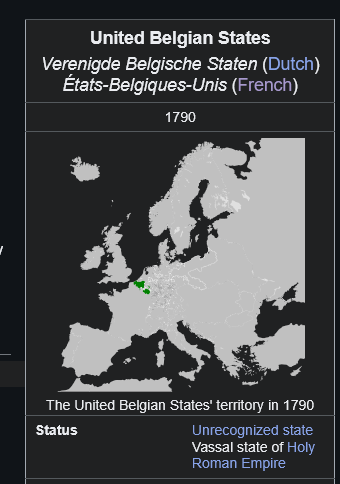
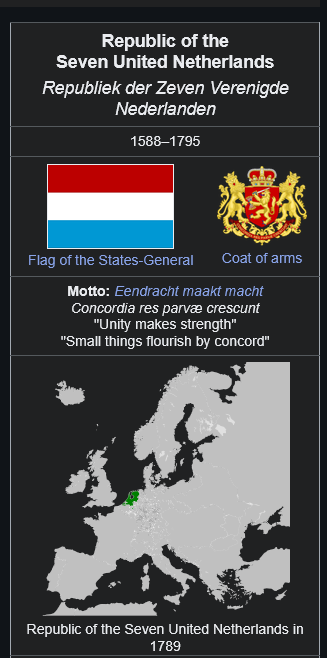
I wonder if the US founders knew about the Netherlands and thus tacked on “Of America”…somehow I doubt it
In the Americas, and in the modern period yes, but the concept was not totally new. Switzerland was a kind of federal state since 1291: https://en.wikipedia.org/wiki/Federal_Charter_of_1291
The Iroquois had a league of sorts that could arguably be considered a uniting of states, stone age though the tribes may have been.
I suppose it was. Good point.
Come to think of it, what bothers me isn’t our name so much as the attitude of so many of my fellow citizens that the rest of the world is of no consequence. Our name puts a fine point on that narrow world view, regardless of whether it was intended that way.
So yeah, I’d rather see the culture change than the name.
Only one of them IS THE United States of America. That’s how names work.
Nothing anywhere says “There are no other states that are united in any geographic region that you can refer to as ‘America’”. That’s just silly.
For example: Mexico is Estados Unidos. I like how they actually refer to the US as EEUU to differentiate. See? It works. You can make things work.
I gave you an upvote because while i’m USian, I firmly believe that “American” is a proper term for people of the United States of America.
I also am fine with the folks (mostly Brazilians in my experience) who want to use “American” to refer to people of the Americas (or the continent of America for those that consider it a single continent).
Both work fine.
It’s usually pretty darn clear from context which is meant, just like with Georgia (a US state and the English name for a country).
It’s always clear from context. In English “American” means a denizen of the USA. Spanish and Portugese have different words for that.
You sound like you think you’re disagreeing? Because we agree
Just not leaving wiggle room for contrarians.
it has a united military
And federal government.
With Israel
Same reason nazis put socialist in name but promptly killed off socialists and trade unions.
authoritarians employ the double speak because they are liars at the root of their beliefs
like NATO is an occupying army in the countries they have bases and not a defensive cooperative force
ml’s live in an alternate reality cult
There was a point where the National Socialist Party was actually socialist. But Hitler and his ilk saw a party with popular momentum, joined it, co-opted it, and betrayed the socialist ideals.
I have no idea where you got this from, but it’s totally false. They were never a socialist party. They had some prominent members who supported strong social programs but that doesn’t make them socialists.

Is this Stephen miller or Anton lavey
Close enough. Fetterman. Sold himself as a hard working everyman, but he’s closer to Kid Rock.
Maybe he got some brain worms from RFK. Democrat in name only (DINO).
That term is kind of meaningless these days.
Yes
Nope. There never was. They were always faar right. They from beginning were a nationalist group that despised democracy. Even before hitler joined them

Do you have any evidence for this, because I’ve studied history, and I’ve never read anything that indicated the “socialist” part was anything but a scammy populist virtue signal?
same as why maga says its going to make things great or make bills they call beutiful.
Because they started off as communist revolutions
A revolution without a solid, detailed plan for how to actually run the country afterword is just teenage angst exercised at a larger scale.
“We’re going to be a social anarchist commune!” does not count as a plan. It’s an aspiration at best.
If there is no plan laid out, with strong community buy-in, then what always happens is that the “revolution” gets co-opted by someone to serve their own power-hungry ambitions.
They have a concept of a plan
The larger problem of projecting is universal, and worse if the west if anything. No child left behind is to leave children behind, big beautiful bill is ugly, take any republican bill, it’s all opposite, which is not substantially different from these other countries having an ironic name.
It’s not communist or capitalist, it’s authoritarian.
and fascists took advantage of the resulting power vacuum.
Not fascists. Fascists need expansionist military conquest for the regime to survive. When authoritarian communism goes bad, it’s able to survive by The Revolution. The Revolution justifies any act, no matter how brutal and misguided.
Fascism justifies itself through conquest and extermination of “lesser peoples”, like the Slavs or the Palestinians.
It’s a reflection of the state’s original aspirations—the justification it used to overthrow the preceding authoritarian state.
The problem is, the more significant the social/political changes are that you’re trying to enact—and the more entrenched the preceding regime was—the more tempting it is to turn to authoritarian methods to cut through the pushback. But once you start down that path, the means inevitably become the ends.
Nothing about this is inevitable, use of force does not magically obligated one to continue using force or to use it inappropriately, wielding authority does not magically corrupt people, these are the direct result of material conditions and different conditions can and do have different results
State-scale institutions are always conglomerations of adaptive subsystems (or quickly become so, if they’re not completely dysfunctional). This institutional ecosystem selects for subsystems that use state institutions to perpetuate themselves—and its these systems, not the individuals within them, that increasingly evolve to exploit the state’s authoritarian powers.
Cool story
This is deep man
It’s an introductory lie. It supposed to get you used to lying.
It doesn’t work on everybody. You must be one of “THOSE”.
The more corrupt the leaders of a country are, the harder they protest that the country is anything but.
This, by the way, applies not just to in the name of the country explicitly including an ideal, but also to harping on, and on, and on about how the country is such a great beacon of an ideal (like they do in the US and UK about being Democratic all the while having First Past The Post voting systems).
I would say that the general rule (applied to people in all situations, not just in politics) is that if you feel the need to constantly state or imply that you or your group have some great quality, you don’t have it.
Probably for the same reasons you do not visit the forum, do not own slaves, and let women vote. You have a different understanding of democracy than the ancient Greeks. That is how it is with them too.
Cause you expect the west hegemonic definition of democratic.
Is there a competing definition of democratic?
Many, yeah.
https://en.wikipedia.org/wiki/Types_of_democracy#Other_types_of_democracy
“People’s Democracy” is one - https://en.wikipedia.org/wiki/People’s_democracy_(Marxism–Leninism)
The Marxist view is that capitalist countries are anti-democratic because the bourgeois class has the power to both sway elections and exert influence over people’s lives outside of the political sphere. True democracy means a state that actually represents the people’s interests, which in turn requires suppressing the political influence wielded by the rich.
The liberal view is that the state’s capacity for repression is uniquely dangerous, and so freedom just means being able to act without interference from the state (not from private entities), and what determines whether a state is free or not is whether it adheres to certain principles. In that view, a Marxist state that represses the bourgeoisie is violating the principle against political repression, and is therefore not democratic.
On the other hand, Marxists point to things like capitalist states repressing strikes to show that in those countries, the state is also willing to act on behalf of the people who control it, and that that this whole idea of a state being constrained by “principles” or “norms” and somehow being independent of class conflict is nonsense and just not how politics works. This is because Marxists view ideas as being the products of material conditions and material interests, and so any such “norms” or “principles” are only as strong as whatever class interests are invested in upholding them.
bourgeois class has the power to both sway elections and exert influence over people’s lives outside of the political sphere.
That is absolutely a fair criticism.
But is there anywhere doing or attempting democracy by your definition?
Vietnam and Cuba would probably be some of the best examples I think.
You can’t seriously be calling Cuba a democracy.
Vietnam is not a democracy. It’s a single-party state where the Communist Party of Vietnam is defined as the perpetual leadership in their constitution.
Hi, welcome to the conversation, you should probably read the things I already explained.
The liberal understanding of democracy (that you’re operating on) is constraining the power of the state, while ignoring class conflict. The Marxist understanding is a state where the people have succeeded in class conflict to the point that they are able to wield the state against the bourgeoisie, while keeping them out of power. The fact that the communist party has secured power is not somehow a strike against Vietnam, from the Marxist view.
It’s always funny to hear this scaremongering over “one party states.” I live in the US, where I have a choice between one party that represents the interests of billionaires and another party that represents the interests of billionaires but also hates gay people. When I vote for a third party that’s actually in line with my interests, everyone hates me for it. And you know what they say? “The primary is where you’re supposed to choose who you like, but then you have to get behind them, to stop the Republicans!” Well, even single-party states still have primary processes, and in a case like Vietnam, you don’t even have to worry about the threat of an entity like the Republican party coming to power, thanks to the structure of the government suppressing the political power of the right.
If a one-party state is so horrible, it implies that the Republican party (and similar parties in other countries) existing is somehow a good thing, somehow fulfilling a necessary condition for a country to be a “democracy.” Even though it’s controlled by a tiny fraction of society and uses every ounce of political power it has to subvert and oppose popular policies!
With that being said, you don’t even have to be a member of the communist party of Vietnam to run and hold office in the country. You don’t have to be a part of any party, you can run as an independent, and people do.
And yes, ditto for Cuba, I am “seriously” calling it a democracy.
In the West we’ve been getting 50/50 splits on voting, whereas out east it’s all 99/sent for re-education. Which of these seems more hegemonic to you?
In the West we’ve been getting 50/50 splits on voting
Close elections are a fairly meaningless metric, especially when all candidates agree on certain key issues.
whereas out east
“Out east?” Where? There’s tons of different countries with all kinds of different governments in what’s classically considered the East. There isn’t even a Comintern to generalize about, but it doesn’t seem to slow you down at all.
Have you actually studied the government structure of, say, Laos? I doubt it. So, where did you get this information you’re confidently repeating about it? Mind-boggling how liberals will just say shit. Lazy stereotyping at best.
Elections≠Democracy. Again, you are expecting liberal west (or hegemonic) “democracy”. I am not making a moral judgement of either, just trying to explain that the definition of democracy that has been shoved to the people’s brain of the global north (hegemony) is not the only or the correct one.
Unfortunately nuance has no place here, nor does the anti-colonialist context or distinction between party and governance.
What does hegemony mean here? And what would a non-hegemonic democracy look like?
I mean it in Gramsci’s terms. For the second question I would say the ones cited by OP are good examples but horizontal organization is my preferred one, look about EZLN ways of horizontal democracy. Again not saying they are the correct or morally good ones either.
the ones cited by OP are good examples
How is North Korea a democracy?
EZLN ways of horizontal democracy
These seem to be distributed communities that internally use direct democracy (public assemblies). And I agree that direct democracy is a form of democracy. A very inefficient form that doesn’t scale past the size of Greece or EZLN, but still a democracy.
Voting is incredibly minimal at best but has marginally expanded since 2023 with some primaries.
North Korea is basically if a trauma victim was a country, shellshocked after a genocidal bombing campaign. Blowback Season 4 goes into crazy detail about the war. That’s what caused them to pioneer the tunnel technology we saw in Vietnam and also Gaza today.
Neither of those supports the stance that it should be considered a democracy though…
Like Citizens United bringing the division and destruction
Because revolutions are unreliable. A communist revolution happened, the revolutionaries were flying red flags and fighting to end the old order and bring in a communist utopia. But someone who wanted power and didn’t care about the ideals took charge, probably murdered the communist leadership and set up an authoritarian government under the name given by the communist revolutionaries.
The people’s republic of China is different - the communists won and named their country revolutionary style, but found themselves in charge of a massive high population empire. They became authoritarian to manage the country (because communism isn’t able to manage even a small country)