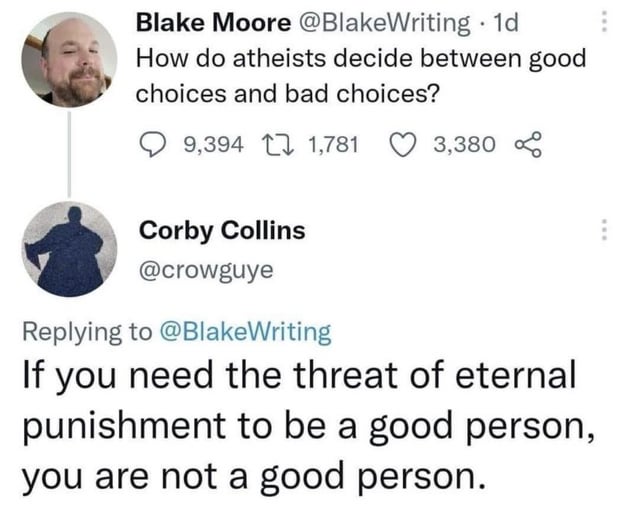
If you need the threat of eternal punishment to be a good person, then you are not a good person.
This argument is the same that Kant made. Kant defended the notion that a person should do the correct thing for the sole reason that it is the correct thing.
Okay, but the assumption of correctness is a consequence of accrued education and experience.
What is the correct response to being slapped? Do you return in kind? Do you kill the perpetrator to restore your honor? Do you turn the other cheek? Do you call the police? Do you bluster, remain stoic, or cry out in pain? Do you apologize or argue? Do you stand your ground, advance, or flee? What is the correct action? There are a dozen different answers.
The premise of a Biblical Law (and, really, all laws and customs) is to establish a single assumed acceptable response. And the real threat of failing to follow this law isn’t “eternal damnation” (an idea that wasn’t really even canonical until the turn of the millennium) but social ostracism and legal reprisal.
The existence of a consequence also doesn’t establish whether or not you’re a good person. The purpose of consequences is to encourage good conduct. You follow the rules because you believe they are righteous. And you enforce the rules because you believe they are righteous. You recognize goodness of a general public as a predicate for social safety and economic prosperity. And you hold to an “eternal reward/punishment” as a consequence that goes above any individual actor’s failure to identify or prosecute bad behavior, because you see the net consequence of bad conduct in the aggregate as a kind-of Hell On Earth for the rest of your people.
That’s why Hobbes and Locke and even Machiavelli posit a better rationale for virtuous conduct than Kant. They see past the “honor system” and recognize the real macro consequences. Societies that fail to meet some basic standards of decency devolve into miserable, violent slums and cultish backwaters. They are damned in life long before they face a judgement after death.
I think this is also why there’s more “criminality” in opressed communities. Why would I work or sacrifice to uphold a system that is unfair to me? If I don’t believe in it, if I don’t see benefit from it, why should I attach my own ethics to it?
I didn’t downvote the other person… but isn’t it kind of a disagree button? What are the buttons for, if not to vote up the things you like, down the things you don’t, and thus float the “best” to the top?
I guess one can respectfully disagree, given that we’re kinda debating philosophy, or one can structurally disagree, and maybe those result in different kinds of voting behaviour.
I agree with the first person about morality determining how to respond socially. For example, why is killing someone in self defense necessary? Why shouldn’t you just run? Responding to violence with violence could be bad if someone else thinks that you weren’t in enough legitimate danger. Similarly, is it ok to kill if you are protecting someone else? What if the person you were protecting did not feel that killing was necessary?
I don’t believe that you are picking up what I’m putting down. Why shouldn’t you die instead? Why do we consider it understandable to defend yourself to the death? Obviously it is because we value lives more than whatever the other person wants that drives them to attack someone, but there isn’t a strict reason for that beyond social acceptance. We could just as easy decide, as a society, that those who can’t defend themselves should be culled. Or that murder is so incomprehensible that there is no reason to consider it.
Murder and death are obviously extreme examples, but you work that idea forward to charity, politeness, and social contract to yield to a government authority.
Regardless, ancient scripture is no foundation for morality. It’s simply what people came up with thousands of years ago before moral foundations got properly built. It took all that time to develop because tradition held humanity back.


This argument is the same that Kant made. Kant defended the notion that a person should do the correct thing for the sole reason that it is the correct thing.
Okay, but the assumption of correctness is a consequence of accrued education and experience.
What is the correct response to being slapped? Do you return in kind? Do you kill the perpetrator to restore your honor? Do you turn the other cheek? Do you call the police? Do you bluster, remain stoic, or cry out in pain? Do you apologize or argue? Do you stand your ground, advance, or flee? What is the correct action? There are a dozen different answers.
The premise of a Biblical Law (and, really, all laws and customs) is to establish a single assumed acceptable response. And the real threat of failing to follow this law isn’t “eternal damnation” (an idea that wasn’t really even canonical until the turn of the millennium) but social ostracism and legal reprisal.
The existence of a consequence also doesn’t establish whether or not you’re a good person. The purpose of consequences is to encourage good conduct. You follow the rules because you believe they are righteous. And you enforce the rules because you believe they are righteous. You recognize goodness of a general public as a predicate for social safety and economic prosperity. And you hold to an “eternal reward/punishment” as a consequence that goes above any individual actor’s failure to identify or prosecute bad behavior, because you see the net consequence of bad conduct in the aggregate as a kind-of Hell On Earth for the rest of your people.
That’s why Hobbes and Locke and even Machiavelli posit a better rationale for virtuous conduct than Kant. They see past the “honor system” and recognize the real macro consequences. Societies that fail to meet some basic standards of decency devolve into miserable, violent slums and cultish backwaters. They are damned in life long before they face a judgement after death.
I think this is also why there’s more “criminality” in opressed communities. Why would I work or sacrifice to uphold a system that is unfair to me? If I don’t believe in it, if I don’t see benefit from it, why should I attach my own ethics to it?
I can’t believe someone made such a good post and still got downvoted for it. It’s not a disagree button…
People are getting downvoted for pointing out the obvious logical fallacy in the op too, so yeah.
I didn’t downvote the other person… but isn’t it kind of a disagree button? What are the buttons for, if not to vote up the things you like, down the things you don’t, and thus float the “best” to the top?
I guess one can respectfully disagree, given that we’re kinda debating philosophy, or one can structurally disagree, and maybe those result in different kinds of voting behaviour.
Not really, no.
Would you want x done to you?
If not, don’t do it to others.
It’s as simple as that.
I wouldn’t want to get bombed. Therefore, I refuse to defend Ukraine against Vladimir Putin, because it might involve bombing other people.
I wouldn’t want to get fired, therefore I will not remove a direct report who is sexually harassing a coworker.
I wouldn’t want to gain weight, therefore I will refuse to feed my young child.
We’re taking about morally good and bad here.
Killing people in self defense might be necessary, but that doesn’t make it good.
Killing people is morally bad, even if it’s someone no one in their right mind would hesitate to murder if given the opportunity, like Putin.
I agree with the first person about morality determining how to respond socially. For example, why is killing someone in self defense necessary? Why shouldn’t you just run? Responding to violence with violence could be bad if someone else thinks that you weren’t in enough legitimate danger. Similarly, is it ok to kill if you are protecting someone else? What if the person you were protecting did not feel that killing was necessary?
If it’s truly necessary, there’s no option to run - no alternatives - it’s your life or theirs.
I don’t believe that you are picking up what I’m putting down. Why shouldn’t you die instead? Why do we consider it understandable to defend yourself to the death? Obviously it is because we value lives more than whatever the other person wants that drives them to attack someone, but there isn’t a strict reason for that beyond social acceptance. We could just as easy decide, as a society, that those who can’t defend themselves should be culled. Or that murder is so incomprehensible that there is no reason to consider it.
Murder and death are obviously extreme examples, but you work that idea forward to charity, politeness, and social contract to yield to a government authority.
Morality varies widely by individual and culture.
Pro-Life folks have been saying this for decades.
Ffs, Zionists have been saying this.
You need more than just platitudes to build a moral foundation
Regardless, ancient scripture is no foundation for morality. It’s simply what people came up with thousands of years ago before moral foundations got properly built. It took all that time to develop because tradition held humanity back.
By what standard?
Killing people is wrong. This is an immortal and unquestionable truth that everyone has always agreed upon
We didn’t have a proper moral foundation until very recently, so disregard everything older than several hundred years ago.
What?
Like putting the shopping cart back where it belongs