You must log in or register to comment.
It’s funny how the word “tolerance” already implies that something is bad but you just act as if it’s not. You wouldn’t tolerate having enough food and water, you’d only tolerate the lack thereof.
Because its a bad faith argument.
Not “bad”, just “not your preference.” I tolerate reality TV like 90-Day Fiance but it’s not objectively bad. And, subjectively, it’s better than most reality TV I’ve seen.
I tolerate eating Shin ramyun noodles when I’d rather be eating pad thai.
Similarly, you can tolerate people’s life choices (e.g. “polyamory, as a relationship choice, or smoking weed”, not “being gay or being trans” which is someone’s intrinsic self) even if they’re not your preference. And that doesn’t imply anything about the choice.
And, as an aside, I think political polarization has erased the place of “tolerance” in discourse. Because now, tolerance looks like acceptance when a bigot wants to murder someone for choosing different. You have to vocally, enthusiastically be an ally to counteract the polarized hatred from the other side, and maintain some semblance of the world making sense.
It implies something has to be tolerated because it is outside of the realm of the familiarity you would otherwise personally accept innately. Not bad, just an admission of the fallibility of personal experience at being completely objective at everything.
Karl Popper is also the guy who wrote about falsifiability
Big brain right there.
Edit: fixed the link.
I see so many people fall into the trap of spouting unfalsifiable statements when talking about AI.
Yup. It’s hard to have a conversation about anything when any given side is arguing from emotion, and defaults to accusing the other of being inferior or stupid. It’s infuriating.
Legalizing tolerance is a method co-opt a liberal regime into fascism.
Take anti-semitism laws in germany and protesting the Israeli genocide of palestinians for example.
Or the UK…
A counter example, Ireland.
that is legally forcing intolerance though, not tolerance. Legally forced tolerance is like the first amendment to the constitution that legally protects all political beliefs including those that all women should be shot
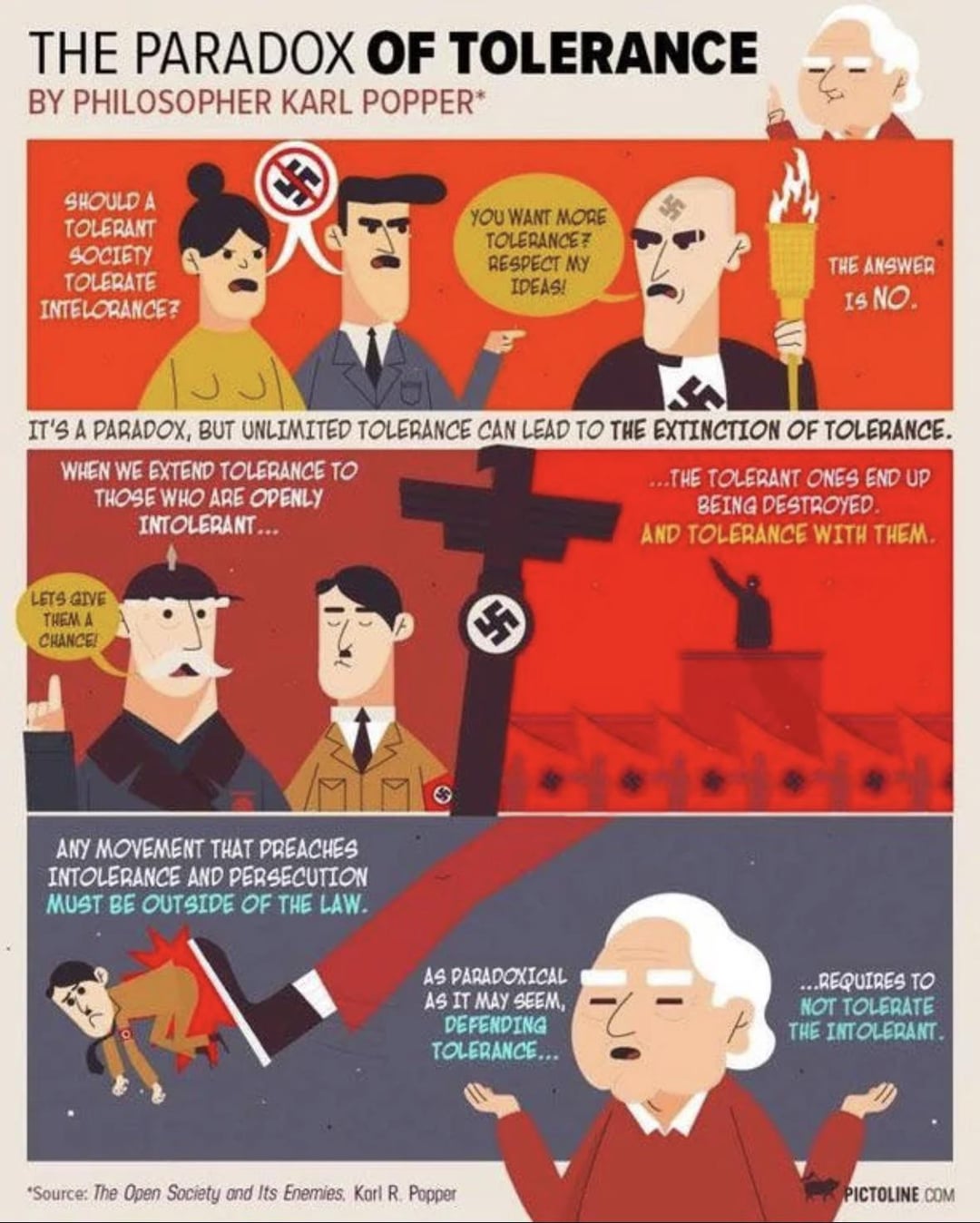
“Any movement (of intolerance)… … must be outside the law.” Is what I’m getting at.
When you create legal structure around that idea, you create a cudgel for the state to use on its citizens.
Protesting genocide in palestine isn’t antiemetic, yet people are getting locked away as terrorists on the basis of “anti-discrimination” law.
The first amendment is in direct opposition to the argument of this comic, if for no other reason than that single line of text.
Absolutes are absolute bullshit.
Only the Sith deals in absolutes wise sounding bong O.o
Absolute Zero?
…all of them
Absolutely.
Indubitably

So, not to revive an old thread, but I have to say thank you for sharing this. I binged the whole series in the last two weeks. Magnificent.
It’s soooooo fucking good, right?!!! I’m just upset that I started reading it so close to the end, as I thought it was already done when I started it last year. And now I’ve passed the curse of longing onto others.
I will offer you this, I didn’t realize on my first go around that there are additional details upon hovering over the comics with a mouse, which has led me to a second reading. It has clarified a lot
Crap on a stick. That’s such a common web comic thing. Because I ready the majority on a touch screen I forgot to even check for that.
Oh well, it’s in my folder of comics now. I’m since I’m caught up, I’ll probably let a backlog build up again for a month or two, and that’ll probably get me to re-binge chapters at random.
What’s this from?
https://killsixbilliondemons.com/comic/kill-six-billion-demons-chapter-1/
Kill 6 billion demons. It has some of the most emotionally honest, colorful, and complex characters that I’ve read in a comic. And the art is so careful. It’s a modern classic. And free!
Thanks, I’ll have to check it out!
Oh shit, another reader of the best long running webcomic!
I found it on lemmy, and it must metastasize!
What the flip is this, looks rad!
https://killsixbilliondemons.com/comic/kill-six-billion-demons-chapter-1/
Kill 6 billion demons. It’s a vast, well crafted universe with intricately crafted characters who are never forgotten or discounted. It’s a deconstruction of the hero’s journey that doesn’t ever overstay its welcome. It’s an allegory for modern and ancient and interminable and spiritual and human woes. It’s pretty good.
Thank you so much, just added it to my reading list!
There’s a straightforward way to resolve the paradox of tolerance, IMO. Treat tolerance as a social contract. An intolerant person has explicitly rejected the contract.
Fully agree. Being tolerant is part of the social contract. If you break the rules then why should we play the same game.
I agree. Straightforward and simple. But I don’t think I know how to simply explain what a social contract is to someone. Does anyone have a good example of a social contract?
An agreement made to be able to share each other’s space
Mutual assurances of safety in exchange for mutual acceptance of limits in regards to your shared spaces
If you break one of these agreements to others then you lose the privileges that they offered you
By demanding the benefits of a society you commit to honoring what it requires of you to maintain it
Look at stuff like the rules applied by hikers in the wilderness. “leave no trace” and sharing resources. Then you filter out a ton of the complexities of cities to show the basics of what it is.
Choose to fit your audience:
-
If you deny my right to exist, you forfeit yours
-
Fuck around and find out
-
Talk shit, get hit
You forgot one:
- Act only according to maxims which you would have be universal
In other words, don’t do something that you would be upset if someone else did.
This doesn’t work in everybody. There’s a lot of things I like, and I would want everybody to do, that I recognize most rational people would never want.
If I followed this advice I would bother almost everybody I interact with.
The majority set the vibe. It’s ugly, but there it is. If I reject this it will only cause friction in my life. So for people like me, a better quote is:
Act only according to maxims which those affected would have be universal
Perhaps. But the same would apply to the other golden rule. It’s not “Do unto others as they would have you do unto them.”
If you do what you feel is right, it doesn’t matter if people disagree with you. You’d at least be ideologically consistent, not a hypocrite.
If being a good person requires pleasing people, there would be no good people in the world. “People” are impossible to please because it’s an abstract category representing a generalized collective. You’ll never please them all and that’s okay.
Do what you believe is right, and sleep well at night knowing you tried your best.
If I remember correctly, Kant goes into detail about how others would be affected and how that influences the categorical imperative. I forget exactly what he says about it though
If your definition is “do what you believe is right” it absolutely needs to be paired with a requirement to put effort into figuring out what actually is right.
Well when you figure that part out let me know, I’ve been trying my whole life and so far everything I’ve come up with is bound to still piss someone off…
If your definition of right and wrong is based on what gains approval from others then you’re in a very dangerous predicament and I hope to the gods I don’t believe in that you’re surrounded by decent people.
nah, it’s more than arrogant to assume you know what others want, and ignorant to assume others want the same a you.
This. I’m not sure why others are arguing your point. I guess they don’t actually understand what you’re saying?
Happens all the time to be honest
-
Not a cool guide, nor a coherent argument, nor a good representation of Popper’s idea.
Can you provide a better one?
I’m not sure which, so I’ll give all three:
Cool guide: https://mir-s3-cdn-cf.behance.net/project_modules/disp/f059d619951639.562e313fcec6b.jpg
Argument: https://www.youtube.com/watch?v=ohDB5gbtaEQ
What Popper meant: https://plato.stanford.edu/entries/toleration
In the immortal words of Karl Poppa:
La jiggy jar-jar do, duhduhduhreduh
There are different types and expressions of tolerance, so I think getting tied up in knots about a mythical all-encompassing tolerance that no cunt on Earth preaches (not even Jesus or the Buddha) is probably a side quest that doesn’t need completing. It’s like two linguists who’ve read a class of philosophy having a grammar nazi stand-off. You may as well include being abused and conned by criminals in that kind of tolerance, which is obviously stupid, but it’s no more stupid than thinking your personal philosophy is threatened when faced with a nazi whose goals you wanna prevent coming to fruition.
Tolerating people who have characteristics that are not necessarily of their own choosing is not in the same ballpark as tolerating those who want to eradicate that first group. “Leave people alone” is better, it includes preventing the non-leaving alone of people by cunts, e.g. nazis, with no paradoxes involved. “But leave me alone to be a nazi!” ok, what does being a nazi involve? “The sterilisation and extermination of…” lemme just stop you there. Done!
The whole confusion comes from upholding tolerance as a principle or ideal rather than actually understanding it’s purpose. When people look at it that way, they either accept it or reject it, but both of those are wrong.
Where does the idea of tolerance come from? Hundreds of years ago, the West was wracked with constant wars of religion between Catholics and Protestants, on top of witch hunts, crusades, inquisitions, the whole “scarlet letter” thing. It was after this whole mess that people decided that it wasn’t worth it anymore, and that we should just call truces, that we should allow each other to practice different faiths without coercion. Eventually, this expanded to other aspects beyond just religious beliefs, however, the fundamental core of what it is is that truce between religious factions.
In many cases, it is possible to discuss disagreements and resolve things, or, it is possible to coexist while believing different things. Whether the sacremental wine turns into the blood of Christ literally or figuratively is a perfect example of that.
However, it should be noted that this was a practical compromise driven by a balance of power between the respective sides. The word, “tolerance” should not be confused with the word, “acceptance.” To tolerate something implies that you wish it were different, and you’re just putting up with it out of necessity. It is a truce, a contract, a ceasefire, between different parties with conflicting aims and ideals. Go back in time and give either side modern assault rifles, a clear advantage, and they’d drop the idea of tolerance in a heartbeat.
When a ceasefire is violated, a certain degree of patience is called for. Itchy trigger fingers can destroy a peace that both sides are invested in maintaining. However, if one side is able to repeatedly and brazenly violate the ceasefire without consequence, then the ceasefire is essentially dead and no longer serves a meaningful purpose.
To view tolerance as a principle and ideal in itself means that you’ve already decided whether you’re going to uphold or abandon the ceasefire before you’ve even seen how the other side is acting. Accepting tolerance on principle means letting people take advantage of you, while rejecting it on principle means alienating potential allies.
Obviously, it’s impossible to tolerate the right because they are so intent on aggression against vulnerable people. However, and this is true, it is possible to tolerate different perspectives on the left, while disagreeing with them. Rather than letting one’s experiences with the right inform their approach to tolerance in general, we should look at what is actually minimally necessary to coexist and potentially collaborate with people we disagree with. Instead of logicking one’s way into saying that anyone who disagrees on any point is technically being intolerant and therefore paradox of intolerance, deplatform them and treat them exactly like fascists, consider whether they are actually being bigoted and intransigent, or whether it’s more mundane disagreement.
I’ve got one for you:
If you wish to be tolerated, you must yourself be tolerant.
Paradoxically, the paradox of tolerance is most often cited in the course of branding someone as “intolerant” and thereby excusing your intolerance of them.
Its a problem of semantics. Who really is sufficiently intolerant to be intolerable?
It’s a question of what they’re intolerant of. Innocent people, or malignant people?
There may still be ambiguous points, but they’re much smaller and fewer.
It’s not a paradox, it’s a social contract.
I am tolerant of everyone except those who are intolerant of people doing things that hurt no one and/or those who hurt others.
You don’t like Nazis? Tolerance granted.
You don’t like trans people? Tolerance denied.
It’s incredibly simple to understand, isn’t paradoxical and is easy to live by.
This is why they are trying to make “establishment” a slur
So if someone says something racist or transphobic, I can kill them, right?
Or perhaps what constitutes a violation of the social contract and what constitutes an appropriate penalty is actually not simple.
To provide a concrete example; the Catholic church, as an organisation, doesn’t like trans people. What would tolerance being denied to the Catholic church look like in your world?
Something something due process, proportionality principle, etc. This isn’t exactly trivial, but that first rule does help in determining who is the one infringing. To start with, both starting shit as well as unjustified escalation are both punishable.
It doesn’t really help in determining who is doing the infringing either. There are places where saying “from the river to the sea” would be considered to be infringing on the social contract. And given that the social contract is a social construct, who’s to say they’re wrong?
yes, and the legal framework can (and should) differ from the social contract
Horseshoe theory in action