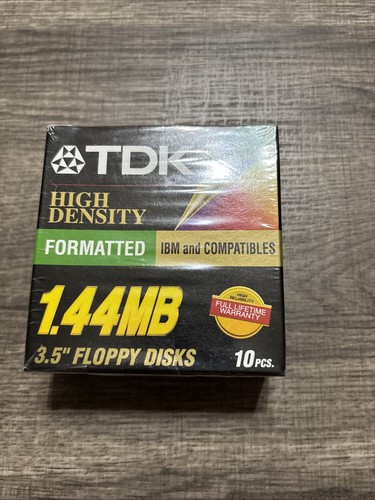
The raw capacity of a 1.44MB 3.5” diskette[0] is 2MB, 1MB per side. The FAT12 formatting chews >25% of its usable capacity. I realised this when the ‘backup’ systems for the Super Nintendo could write a 16Mbit cartridge to a single diskette.
This raises the question: Is a console game up to 2MiB eligible?
[0]: 3.5” are diskettes, 5.25” and 8” are floppies.
No, they’re all floppy disks. Cause the platter was floppy, even if the disk wasn’t.
[0]: 3.5” are diskettes, 5.25” and 8” are floppies.
Not a distinction that I ever heard, and I lived thought the 5.25" and 3.5" eras.
I lived through all 3, and I’ve always called them diskettes. My recollection is they were called that in the original Sony documentation, which appears to be elided from my brief searches this evening.
I’ll chalk it up to colloquial laundering, much like all 8P8C ports and cables now being called ‘Ethernet’.
Lots of manufacturers called them lots of different things.
Just think how much more breathing room people coding for boot sector games would have
Procedural generation.
Procedural generation everywhere.
I’d love to see a basic Minecraft clone clock in under 1.44 MB
Probably possible with no textures, or procgen’d ones.
Yeah .kkrieger a 3d FPS is only 96 KB and it achieved that with procedural generation.
quod is even more impressive at 64kb https://daivuk.itch.io/quod
There’s chess games in less than 50 bytes.
Not with the logic included
How about an OS and games?
Holy moly, this is insanely awesome. Can this revive Chromebooks and ancient machines? Can it actually play YouTube videos with sound, though?
It is mostly an incredibly cool hobby project, nothing that you can daily drive nor something that strives to be daily drivable
Best I can do is 60GB of AI generated assets for my farming/life simulator
How about a full 100MB to honor the late not-so-great Zip drive?
And, to further honour the Zip drive, every game submitted must be corrupt and unreadable.
WASM-4 would good engine for this. Assuming you don’t also have to ship the runtime.
Games are at most 64kb.
It seems they’re including the runtime in the size, and have prohibited web based games for this reason (unless you can find a browser that fits in 1.44MB). Submissions must be a native executable (I’m assuming for x86)
Well technically since it compiles to wasm you just need a wasm runtime and a rendering system. Not a whole browser. Some people have reported getting wasm-4 games running on microcontrollers.
I’m sure you could do it with a standalone runtime, but it will just be overhead compared to compiling directly to x86, at least for the purposes of this competition. I’m a fan of WASM for a lot of other applications tho
MS Teams just had a panic attack.
As a result of this panic attack, MS Teams will use 30MB more RAM on the next startup. You should know better than to frighten poor MS Teams, when you know it’s got poor self-esteem!
Teams does that even when running entirely unconstrained.
Plus, it lets you cook an egg in the surface of your laptop.
I would love to see a return to the floppy and old-school computing, esp in response to hardware skyrocketing in price… I know it’s unrealistic but it hits me right in the nostalgia reading about this stuff
Wait, are entrants allowed to spread their game across multiple floppy disks, as was commonplace in the 90s?
Bonus points for saves being written to the floppy without checking if there is important files there already, leasing to a broken game if the save file is put on the wrong floppy.
Just don’t remove the write protection.
Good idea, but then you cannot write the save to the floppy. Some older games would disable write protection to every disk instead of just the one you should store saves on. Lead to a lot of problems, you can imagine.
What? Floppy disks have physical write protection tabs
Yes. Most floppies had a write protect tab you would slide to set whether writing was protected or not. However, when buying games some floppies didn’t have that tab exposed because the write protection was supposed to be set by the manufacturers when they created them for sale. On some games, they messed up and set the disk write protect to the unprotected setting (thus disabling write protection) on ALL of the disks and not just the disk they intended you to use for saves. If you didn’t read carefully, forgot, or were playing a foreign imported game in a language you don’t quite understand, you might accidentally write a save onto a disk you weren’t supposed to, and the games with this problem usually didn’t check to see if there were important files it was overwriting before just writing the save file.
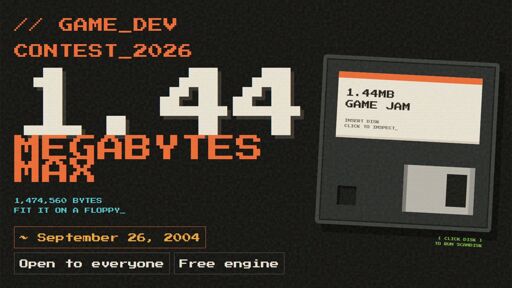
the freshly prepared game must be able to squeeze onto a single HD floppy disk - that’s just 1.44MB
Literally in the first paragraph of the article.
What a great idea.
I love the idea, but it seems like a high (but not impossible) limitation. Godot won’t make it even with heavy minification of a hello-world, Raylib is more realistic but I think the 3D rendering on its own already puts it above the limit so even untextured 3D is out. So, 2D or write-your-own-engine.
Well, maybe Raylib 3D might work with a static binary via musl, but at that point I’m pretty sure game design and programming would be small steps at that point.
Most ready-to-use engines simply cannot compete in these kinds of challenges, they have too much “cruft”. Simply exporting an empty project will result in a ~35mb executable.
Funnily enough, SDL might also not be worth it, as the .dll alone will blow the limit. So people will either have to use whatever native win32 API there are, or directx calls, or going with VGA, which will also look era appropriate.
It’s not clear if dynamic linking is allowed or not (considering it’s something you really have to go out of your way to avoid), which is a big difference.
I was also going by some modified Raylib examples (+bindings, Linux, so size is influenced by that) I already had compiled,
1,372,160 bytesfor the 2D one (no textures/sounds, just collision detection and some polygons). With my original comment I wasn’t even thinking about how dynamic links could be counted for size, only that static linking could be smaller (which isn’t even a guarantee).EDIT: Actually, the 3D one (
yaw_pitch_rollexample with plane replaced with a vertex-painted office plant) is smaller after the binary is stripped.Just the logic
.sofor one of my Godot projects is significantly big (761,856 bytesfor something with ~250LoC) though that might be on the bindings or even my compilation settings.
The best bet is to generate some stuff on the fly or on demand, if you wanna make it 3D
Whoever designed the poster didn’t see a floppy disk on their lives.
Maybe it’s a regurgitate essence of a floppy disk by AI.
That AI ought to be stuck on a floppy for a few years to teach it some manners.
I actually had 5 and a quarter inch floppies as a kid and apparently they cap out at 1.2MB. They had pretty rad games, although I barely remember why we had like, hundreds of them, obtained second hand I guess.
We had hundreds with pirated games for our C64. Alongside miles of printouts to see which game is on which disk.
Boxes with floppies of pirated games.
Good times ☺️
IIRC they were more like 170kb? Single sided (single density). I had the C64 ones.
My family’s IBM compatible had 5¼" double sided double density disks that held 360KB.
But there was a lot of variations between platforms:
I think I can hear .kkrieger laughing scornfully.
I can hear QUOD laughing at .kkrieger’s pitifullly large filesize
To be fair, .kkrieger came out in 2004 :)
Never heard of that one before, neat!
I have played it, it is a damn cool concept, the graphics looks cool but I found the actual gameplay to be rather sluggish.