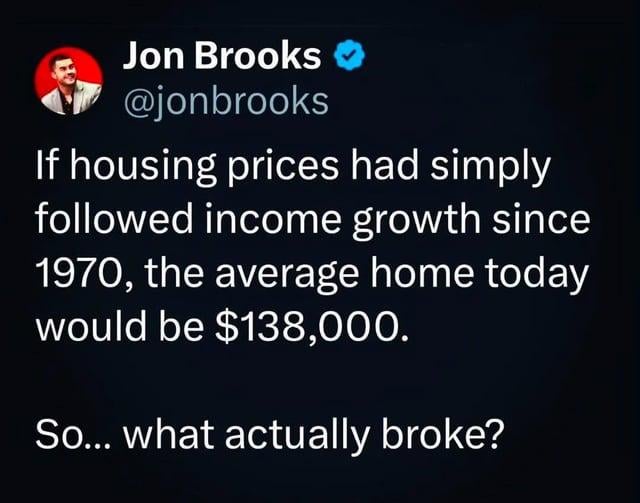
Nothing broke. It’s working exactly as intended.
There have always been two distinct economies.
-
There is their economy (meaning the billionaires economy of venture capital, real estate investment firms, speculative markets, etc…) It’s a market that exists on paper only. Theoretical billionaires with assets instead of bank accounts, capital instead of paycheques. Money isn’t a real concept in that economy, it’s simply a measure of profit and loss. It’s just a score keeping device and something used to leverage power.
-
Then there is our economy. (meaning the rest of us, who get a paycheque, spend that paycheque, etc…) Maybe we’d be able to put something aside for retirement or college for the kids. . Money itself has a real, tangible impact in our lives. It’s not theoretical.
Maybe we have enough to play in the paddling pool of the speculation market, telling ourselves that “we’re shareholders!” like our 10 shares means squat against the 10,000 shares owned by the investment firms and LLCs run by the billionaires. Employers like to do things like offering you stock options, selling it as “you’ll be an owner and have a say in the company”. Yeah…no…you’ll have a piece of paper and a sense of self-importance because you “dabble in stocks”.
The idea being that if we invest hard enough, and risk enough, we’ll make enough to jump us from one economy into the other. But we won’t. That’s the lie they tell to keep us mollified.
Because the truth is that their economy, only works at the expense of our economy. Profit in their economy, only comes from loss in ours. A corporation can’t make more profit without taking it from somewhere. And that somewhere invariably is us; our health benefits, our cost of living, the quality of the products that we use, our lack of raises, etc…
That’s the lie they tell to keep us mollified.
By and large, I agree with what you wrote, but they can always chose to have us shot, “suicided,” imprisoned, institutionalized or simply disappeared. No, they need us to keep their big MLM scheme called “capitalism” running. No base, no top.
don’t worry, they are trying to install anti gravity thrusters on the top of the pyramid
-
Source?
Math.
https://fred.stlouisfed.org/data/MSPUS
Plug 23900 into an inflation calculator
https://data.bls.gov/cgi-bin/cpicalc.pl?cost1=23900&year1=197001&year2=202606
I got 211,149.54.
Guess they had different numbers or calculator, but similar sentiment. Housing grew some 5x+ faster than inflation.
Accountability
“until we reestablish old-school legit full blown slavery (which we will), we have to make do with debt slavery”
-oligarch fascists
They don’t want full slavery. Debt slavery is more cost effective. Why buy a depreciating asset?
the same reason they’ll never ever ever go to a 4 day work week, or allow work from home, even though those things are proven to increase productivity-- maximum possible suffering
also prison slavery, but i heard thats industry not doing so well, since people are going to prison less and less. also prison population declining hurts the gop in the long run, apparently use the population as part of the census.
The wealthy aren’t paying their fair share. They pay way less than they should in taxes and keep accumulating wealth and buying up shit, which of course is coming from us. That then increases prices because more normal people need it.
!twnw@fedia.io #TaxWealth
This is exactly it. All of the other answers in this thread are dancing around this issue without even knowing it. Some happen upon it, but move on like it’s a side item when it should instead be lit up with lights and sirens as the main event.
Regular people spend the majority of their income on the things they need to survive; food, shelter, energy, clothing, etc. The wealthy and ultra wealthy spend only a miniscule fraction of their money on the same things, so they put that pile of remaining money into investments/assets (stocks/shares, housing, etc), which make them even more money, which they put into more assets which make them even more money, and so on. But the money flowing to them doesn’t come from nowhere, it comes from YOU.
Collectively speaking, you go to buy a home, they outcompete you on the price, and then gladly rent it to you, all while jacking up the rent over time. They use that extra money from you to buy even more assets. You somehow manage to buy a home, but at a highly inflated price, the money is lent to you by… guess who. And they charge you interest every month, which is money flowing from you, so they can spend it on… even more assets.
Higher prices at the corporate owned grocery store because the shareholders demand even more dividends. Because goods at the store coming from corporate producers raised the price for the same reason. Because little producers that used to compete in the market are being bought up by big ones that can afford it because they pay next to no corporate tax. But who are the shareholders receiving the dividends? 80% (and rising) of the stock market is owned by the 1%, the people who already have more money than they could ever spend.
Now we’ve got higher prices for energy for a multitude of reasons, but a fresh new hell is it’s all being gobbled to power data centers. Whose ultimate purpose is an attempt to replace people’s jobs with “thinking” computers. Whether they’ll succeed or not is yet to be seen, but we do know it is being funded by billions of dollars that someone has… guess who again. If they do succeed, then that’s even more money sucked away from you in the form of lower wages at minimum. If it blows up in a catastrophic bubble, they will demand a bailout again, just like the sub prime bubble.
Our failure to tax the obscenely rich allows them to walk all over us, taking money from us which they use to build the machinery to walk all over us with even greater pressure, which takes even more money from us, and so on. It’s literally exponential, which is why nobody appreciates nor understands it.
You are not rich, will never be rich. The ones who actually are, are doing everything they can to keep you out of their club. You’ll know because you’ll be paying taxes and they won’t. Which are going to go up soon by the way, to pay for that bailout.
Private businesses being allowed to buy up the market to artificially increase prices and scarcity. How else can you ensure real estate is a solid investment stream?
I think that’s part of it, but a larger part–having been a local reporter–is that government is run by people trying to keep property values high. In cities, that’s real estate developers and landlords. In suburbs, it’s typical homeowners.
Most construction brings down property values: increase supply=lower demmand=lower prices. There is therefore a strong political will to oppose ALL new construction.
The second concern is: how do we keep poor people out? Things like minimal lot sizes are designed to keep the prices up and limit the amount of new citizens.
The third concern is: how can we spend the most of our money on OUR children’s education. Many suburbs are spiritually and economically designed to do ONE thing: get kids into good colleges. That means high property valuations across the board so the most money can go to individual children’s education. There are very many suburbs people don’t even move to UNLESS they’re having children, and they move out when they’re kids leave school.
If you build an apartment building in one of these suburbs and children start moving in, what happens? THe money from the rich houses is now diverted away from the rich children and towards the poor children, who are now paying much less in taxes.
I do like the oligopoly narrative, but we have to face that we are facing MASSIVE FAILURES on a social and political levels. Everybody is scrapping for themselves and building walls and pulling up ladders and basically being as self-interested me-and-mine as possible, at the same time money is becoming the dominant form of political activity with which the masses of regular people can not compete.
Don’t worry, with birth rates dropping like a rock we’ll have plenty of extra houses in a couple generations, assuming humanity can make it that far.
The other factor with much of our development is that it requires an automobile, automobiles that are consistently getting more expensive to buy and repair. We’ve really fucked up.
Doubt it. There are plenty of empty houses right now.
Right now, the folks keeping an empty unit for speculation can afford to keep it empty.
When the less wealthy investors who need to pay a mortgage for their micro-estate empire of 3 units realize the demand is fading, they’ll be forced into lowering rental cost and maybe even selling.
China has seen a ginormous housing value appreciation over decades. The population is shrinking and the correction is happening. It is brutal.
Well no, they’ll sell to cut their losses. To people richer than them.
Yeah, that’s still possible. Corps should be banned from buying housing units. People who buy more than one should be taxed with an increasing rate for each additional unit.
Edit: typo
Fully agreed
No, we’ll destroy houses for freeways and data centers. There won’t be extra supply.
Or they’ll be bought up and turned into rentals. Student houses, Airbnb, etc.
They realized someday people pay off mortgages. No one’s ever paid so much in rent that they stopped having to pay.
And these cancerous parasites are doing it to everything possible, sucking the goodness and value out of the entire planet and life itself, because their greed is a terminal mental illness.
Unfortunately it isn’t terminal.
Good luck curing it before it kills us all :(
This is nonsense. Corporations own 10% of housing. There is pressure but it’s not a primary driver people need to stop parroting this
Homes are treated as speculation and investments. NIMBY ism abound when it comes to density. Expensive labor for new home construction.
These are the primary drivers.
Dude, so much of our area has turned into corporate rentals for when they host guests, or rent them out when not needed for business personnel.
The house close to my parents went for almost 40k over asking last year, so not even in a heated market.
👌👍
There’s probably another 10% owned by individual landlords with 3+ properties as well. It’s driving prices far more than you think. I’m my town something like 37% of single family homes are rental properties, if you don’t think that’s causing insane inflation of house prices in my area you’re crazy.
The biggest issue is lack of construction. We’re building fewer units now than we were in the 1960s, despite having double the population today.
Really basic 100m2 house is 450.000€ here. No basement no lot. Construction is stupid expensive since ukraine war started. Add to this, everytime there’s a sale several people demand processing fees in % of the value including state… This drives prices only up.
Doesnt help that china built their economy on real estate in the last decades, consuming lots of the raw materials. Also ever stricter regulations like insulation, heating, electricity is a point.
Companies buying homes shouldnt exist but we are at 650-750k for a 4 person home with barely any lot without that already.
The biggest reason is the number of households grew far faster than the number of houses. In constrained areas the number of households tripled, while the number of houses grew 20%. There’s no financial reform that fixes that. In remote areas cheap financing and increasing costs for construction are the largest factors.
There’s no single fix to home prices being insane. It’s going to take multiple reforms, and time for markets to adjust, plus homes to be constructed.
I fully agree with the point but is “a erage” the right metric? I also have to imagine even the average house is much larger than in 1970.
I was born into a house in the 70’s that was massive. Sure it was dilapidated but there were big houses. Watch caddy shack and look at the house the main character lives in that you see at the start of the movie.
Average can mean so many things. A lot of people want it to be synonymous with mean as a measure of central tendency, but there’s a reason data people use mean. It avoids folk definitions meaning typical or expected. In those senses it can also be synonymous with modal values or an area around the median etc. It’s not a precise word.
Me, I’m broke
Income growth broke as it hasn’t followed economic growth since the 70s.
The same thing that broke when our cars and food prices got so high. We need to find out what broke before it finally affects the Pokeman cards! /s
Here’s the history of US inflation in a nutshell.*
Lyndon Johnson wanted to have a Great Society and have a quick win in Vietnam. He thought that a big buildup could give the US a knockout blow, but it turned into an expensive quagmire. The US was dropping a dozen Hiroshimas worth of bombs on the jungle every week. This meant that US steel mills were working 24/7 and not getting updated. LBJ is printing money to pay for this, because he doesn’t want to raise taxes.
Nixon comes in in 1969, promising to end the war. Instead he triples down on the policy of printing money and overworking the factories. Then the Arab Oil Boycott hits. Prices of everything jumps. Many small manufacturing businesses either go broke or relocate to non-Union states. All those fancy Manhattan lofts you see today started as factory buildings.
And while the US steel mills were running day and night, Japan and Germany couldn’t get American steel, so they started building their own mills. Mills that needed a lot less power than the aging US mills. Suddenly Americans were willing to buy a tiny Japanese car instead of a Detroit model that got 6 mile to a gallon.
Jimmy Carter gets one term as President before the Iran Hostage Crisis ruins him. Carter hires Paul Volker to run the Fed and save the economy. Volker’s plan works, but it’s Ronald Reagan who gets the credit. Ronnie kept Volker in place.
Reagan has his own version of Nixon’s print and spend policy. Tax cuts for the rich and bank deregulation create an artificial boom in the 1980s that lead to a stock market ‘correction’ in 1987.
When Nixon came into office, ‘middle class’ was one Union job paying for a family of four and $1 million was considered a vast fortune that could buy a dozen houses.
By the time Bush Sr. was done, ‘middle class’ was two incomes to support the household, and $1 million was what a rich guy paid for a party.
*this is a very brief description, leaving out many details.
So… Jimmy Carter is to be blamed? /s
No /s needed. The MAGAs totally believe it.
for a brief description this is very impressive.
Thank you.
Eh… I think this puts a bit more emphasis on the economic impact of US Steel to the overall economic outlook during the post war period.
The steel industry was more important to the US economy from the later 1800s to the post war boom, but a lot of the growth in the US market started to diversify way before the Vietnam war. Automation and the popularization of mini mills hit the US steel industry harder than anything.
The same thing goes for the accusation of “printing money” being the real cause of inflation. In reality the rapid rise in inflation was one of the reasons Nixon moved to fiat currency. The Brenton Woods system was leading to American gold reserves being drained by other nations right when Germany and Japan began to recover during the post war period.
Tax cuts for the rich and bank deregulation create an artificial boom in the 1980s that lead to a stock market ‘correction’ in 1987.
Tax cuts and deregulation is probably the most significant reason we see the wealth gap start to take off. As well as a general change in attitude of CEO like Jack Welch who popularized the shareholder value movement in American business. He pioneered mass layoffs, cuts to pension, and investment cuts to increase paper prophets. Combined with the legalization of stock buy backs and you have today’s modern economy.
It’s a little ambiguous, because US Steel was actually the name of one of the biggest companies.
And yes, I could have written a lot more about Reaganomics, but I wanted to go with a very general outline.
It’s a little ambiguous, because US Steel was actually the name of one of the biggest companies.
Yes, I also could have clarified better, I was referring to the US steel industry as a whole.
Housing is an investment, so the supply of housing is artificially constrained to ensure investments stay green.
For the boomers, the house they bought was an equity vehicle designed to keep them out of poverty in their old age.
There’s also the issue of you, reading this this comment, who doesn’t want a condo or townhouse but a very specific home with a driveway, lawn, and backyard with lots of privacy. The most costly property to provide services and infrastructure for and is crippling every city’s finances for the past 50 years of white flight.
The private corporations buying homes are basically a rounding error. Human desire at scale is what’s doing this to us. Everyone wants a life sold to them as ‘normal’ by Madison Avenue executives in the 50s.
While we’re here, it’s also not data centers killing the planet - it’s billions of people who want to eat beef every day.
-
Private equity buyers absolutely are contributing to housing prices skyrocketing. The percentage of their effect is up for debate, but as someone who bought a home in the last few years, I was fighting big investors that were making cash offers left and right on every house I tried to get.
-
Meat production is one of the largest green house gas emitters, but data centers aren’t helping either. BOTH can be a problem. It’s and AND statement, not an OR.
People point to these two things because they want an easy solution and don’t want to adjust their own behaviors.
If you deleted every data center and banned private equity in real-estate we’d still be in the exact same position.
-
While we’re here… it’s consumerism that’s killing the planet. Waste driven by mass production (this includes beef) are the driving force behind our accelerated climate issues. The company that makes 2 million plastic landfill fodder per day, and dumps chemicals into whatever nearby future super-fund site it can find, is doing a lot more damage to the planet. Eat less or no beef, yes…but consume A LOT less of all the other shit that outweighs cattle farming for global damage.
“There’s also the issue of you, reading this this comment, who doesn’t want a condo or townhouse”
I get this is a popular argument but when someone buys a condo or a townhouse in a shiny new development (granted you didn’t specify new but I see new condo developments being built left and right lately) where does that money go? Developers, many of which are large corporations, are making money hand over fist.
We push for more affordable housing by adding to the supply but that’s helping fatten the pockets of large development firms, further funneling money away from the people who are scraping barely enough money together to buy the units in the first place.
I’m pointing out a problem and not a solution but I think this gets lost in the “more people should be ok with condos and apartments” argument.
Nothing broke, everything is working as intended

Not trying to refute this at all, but I’d love to see this same graph normalized for inflation.
That would be interesting, but I’m not sure how useful it would be given that “inflation” itself is a heavily massaged and manipulated metric. It’s one of the many layers of the illusion that the powers that be craft to separate us from the physical reality of why so many more of us have to work harder for the same or less. It only reflects actual reality to the extent it is politically necessary to so it can maintain some semblance of legitimacy. It may be better than nothing for adjusting such charts but it’s also misleading in its own way.
Needs log scale
I assume it’s mainly that the amount of people went up more quickly than the amount of homes. Demand goes up while supply stays low, and the result is predictable.
I also assume that this is driven by perverse incentive: pre-existing homeowners want their property to appreciate in value, and so they will oppose attempts to build in order to drive scarcity. They will be particularly incentivized to do this if they bought the property as a speculative investment instead of as a home for themselves.
This type of rampant speculation is driven by the market being largely unregulated. Everywhere in the world but especially in the USA, people are forced to seek reliable high-yield investment in order to fund non-state pensions and afford a decent retirement. Governments desperately need to aid this in order for society to not collapse, and so they are held hostage by their own economies, forced to clear a path for pension funds to seek as much profit as possible.
I assume it’s mainly that the amount of people went up more quickly than the amount of homes.
There is an average of 45.9 empty homes in the U.S. for each person experiencing homelessness.
https://www.self.inc/info/empty-homes/ (original sources cited at the bottom)